
Unity didn't just raise its prices. It changed the deal after thousands of studios had already built their businesses on it.
For years, Unity was the engine indie developers loved. Free to start. Pay per seat as you grow. Keep your revenue. Entire companies were built on that promise.
On September 12, 2023, Unity announced the Runtime Fee. Starting January 1, 2024, developers would pay a fee every time their game was installed once it passed certain revenue and install thresholds, up to 20 cents per install on the free Unity Personal plan. And it would apply to games already on the market.
Developers did the math in public. Free-to-play mobile studios, where one install can earn a fraction of a cent, realized the fee could cost more than the game made. Demos would count. Unity's first answer on reinstalls was that they would be charged too, and then it walked that back.
Geoff Keighley, host of The Game Awards, replied to the announcement with three words: "What a joke."
Unity said more than 90% of its customers wouldn't be affected. Nobody cared about the 90%. They cared that Unity had just shown it could change the rules whenever it wanted.
PR Fail
The fee itself wasn't the core failure. Software companies change pricing all the time.
The failure was that Unity announced a new business model as if it were a line item. No warning. No consultation with the studios most affected. Unanswered questions about how installs would be counted. New terms applied to games that had already shipped.
Every question Unity didn't answer, the community answered for it, with the worst possible version.
Then the apology cycle began. On September 17, Unity posted: "We have heard you. We apologize for the confusion and angst." On September 22, Unity Create President Marc Whitten published an open letter that opened with "I am sorry" and admitted: "We should have spoken with more of you and we should have incorporated more of your feedback before announcing our new Runtime Fee policy."
The revised terms kept Unity Personal free of the fee, exempted games under $1 million in trailing 12-month revenue, applied the fee only to the next version of the engine, and let developers pay either a 2.5% revenue share or the install-based amount, whichever was lower.
Ten days, from "new business model" to "I am sorry."
On October 9, 2023, CEO John Riccitiello retired, effective immediately. And on September 12, 2024, exactly one year after the original announcement, new CEO Matt Bromberg canceled the Runtime Fee and went back to seat-based subscriptions, with price increases.
Unity spent a year getting back to a price increase it could have announced in the first place.
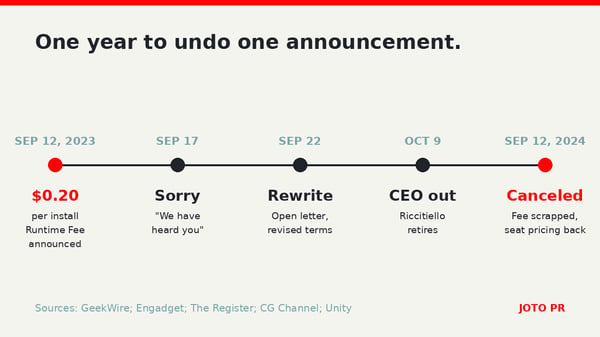
One pricing announcement, an apology, a rewrite, a CEO departure and a full reversal, all in twelve months.
Why It Blew Up
1. It broke the implied contract.
Developers chose Unity years before shipping, and switching engines mid-project is brutally expensive. Changing the terms on games that were already live felt like moving the goalposts after kickoff. We saw the same dynamic when Sonos changed something customers already owned. When you touch what people already paid for, it gets personal.
2. Unity explained the price, not the reason.
The announcement was full of thresholds and rates. It said almost nothing about why Unity needed the change or what developers would get in return. When you don't supply the "why," the market supplies one for you. Usually it's "greed."
3. Vague mechanics invited worst-case math.
How would installs be tracked? What about pirated copies, charity bundles, reinstalls? Every ambiguity became a viral thread. It's the same trap we covered in how vague comms turned OpenAI's governance into drama: silence and fuzziness don't stay neutral for long.
4. The fast rewrite proved the first plan wasn't ready.
Walking it back in ten days was the right call. But it also confirmed the community's biggest fear: the original plan had never been pressure-tested with the people it affected.
The Contrarian View
Here's the unpopular take: Unity's problem was never charging more.
Developers pay for tools. When Unity finally canceled the Runtime Fee, it replaced it with an 8% price increase on Unity Pro and 25% on Unity Enterprise, plus a promise to consider price changes only on an annual basis. In other words, the fix was still a price increase. It was just a predictable one.
The market will accept higher prices. It won't accept unpredictable ones.
In B2B tech, your pricing page is a trust document. Predictability is a feature. The moment customers feel the rules can change under them, every future decision you make gets read through that lens.
What They Should've Done
1. Tell the story before the number.
Why does the company need this change? What will it fund? What do customers get? Lead with that, and the price becomes part of a plan instead of a surprise invoice. This is where research and strategic PR planning pays for itself.
2. Brief the most affected customers first.
Top studios, community leaders, an advisory group. Make sure the first public voices are informed ones, not the angriest ones.
3. Never apply new terms retroactively.
Grandfather existing customers and existing products by default. Unity ended up doing exactly that in its revised policy. It should have been the starting point.
4. Publish the mechanics with the announcement.
How it's measured, what counts, what doesn't, and an FAQ that answers the worst-case scenarios before critics post them.
5. Put a senior leader in front of the community on day one.
Unity's open letter and live Q&A came ten days in. By then, the narrative belonged to everyone else.
Now You Steal This
Before you change pricing, packaging or contract terms, ask:
- Who built their business on our current terms, and how will they hear about this?
- Can we explain the "why" in one sentence a customer would repeat?
- Does this change anything customers already paid for or shipped?
- What's the worst-case math a skeptic will post, and does our announcement already answer it?
- If we had to walk this back, what would we change? Then why not change it now?
If those answers aren't ready, neither is your announcement.
In B2B tech, pricing isn't just a finance decision. It's positioning.
Every price change tells your market who you think they are: partners or a revenue line.
Unity told its developers they were installs. Developers reminded Unity they were the reason the engine existed.
The Anti-PR move is to treat a pricing change like a product launch: narrative first, early briefings for the people most affected, mechanics published, existing customers protected by default.
Raise your prices if you need to. Just don't surprise the people who bet their business on you. Trust is the one line item you can't increase overnight.
Want to see what a narrative-first approach looks like in practice? Explore our Anti-PR case studies or learn what Anti-PR actually means.
…and we'll tell you whether your next pricing announcement will read as a strategy or a betrayal.
Because when your narrative is right, deals move faster. We've helped companies close their biggest clients in as little as 90 days.
Sources
- GeekWire. (2023, September). Here's why so many video game developers are suddenly abandoning the Unity engine.
- Cross, T. (2023, September 13). Unity sparks backlash with new fee-per-download pricing model. VideoWeek.
- TechRadar. (2023, September 13). Unity's plans to charge per game install has developers begging gamers not to download their games.
- Engadget. (2023, September). Unity apologizes and promises to change its controversial game install fee policy.
- The Register. (2023, September 22). Unity apologizes, announces revised Runtime Fee policy.
- Thacker, J. (2023, October 10). Unity CEO John Riccitiello to 'retire', effective immediately. CG Channel.
- Bromberg, M. (2024, September 12). A message to our community: Unity is canceling the Runtime Fee. Unity.
- Kerr, C. (2024, September 12). Unity is killing its controversial Runtime Fee. Game Developer.

Behind the "Black Box;" As 2026 Rx Price Hikes Emerge, SHARx Exposes Specialty Drug Pricing

New Transparency Rules Put Big Healthcare Insurance Networks Under Scrutiny

No Comments Yet
Let us know what you think