
OpenAI fired Sam Altman, gave almost no usable explanation, and accidentally turned board governance into binge content.
There are leadership changes.
And then there are leadership changes that make the entire internet briefly qualify as screenplay writers.
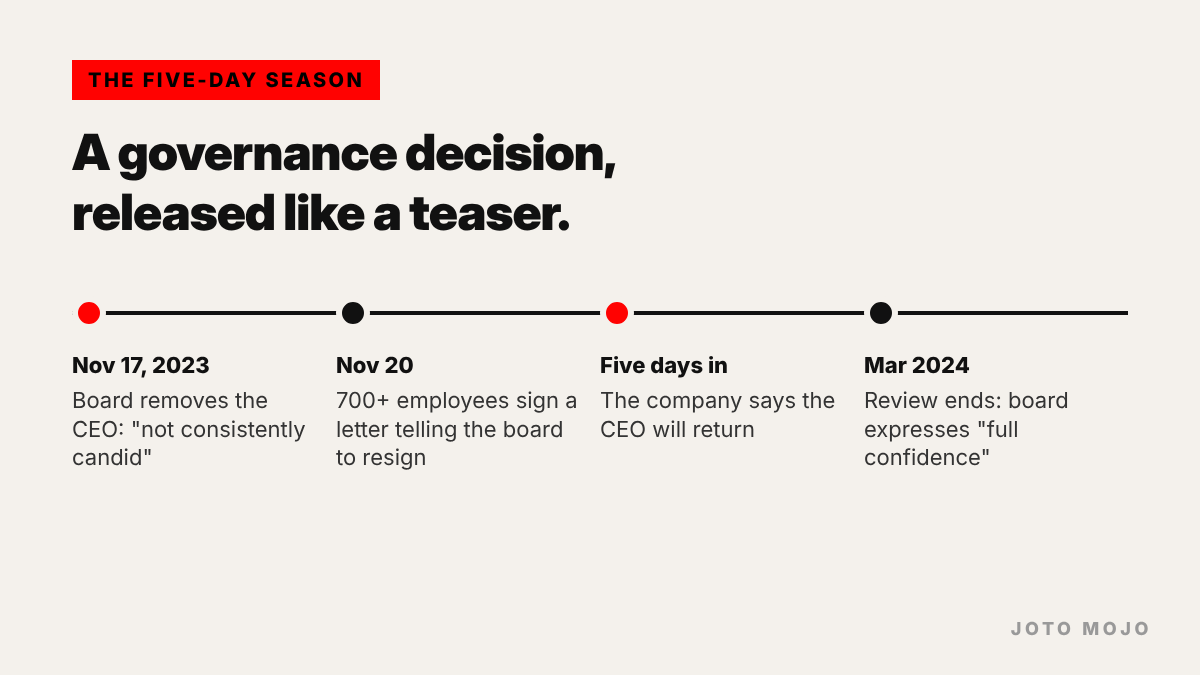
OpenAI spent years positioning itself as one of the most important companies in the future of technology. Then, on November 17, 2023, its board abruptly announced that Sam Altman was out, Mira Murati was in as interim CEO, and the official explanation was that Altman had not been "consistently candid."
That was not a leadership transition. That was a teaser.
PR Fail
The problem was not just that OpenAI fired its CEO. Boards do that.
The problem was that they did it with language dramatic enough to set the building on fire, but vague enough to hand the hose to rumor.
The company gave the public a high-stakes conclusion without the middle of the story. Just like this text. You are probably asking yourself: "but what?". Yeah, take it easy and we will get you there!
So the market, the media, the employees, and roughly everyone with Wi-Fi immediately started filling in the missing episodes themselves. And because OpenAI is not a boring company doing boring things, the speculation machine did what it always does when you feed it mystery and ego: it achieved liftoff.
Then the internal blowback arrived. By November 20, more than 700 employees had signed a letter telling the board to resign or risk losing the vast majority of the company to Microsoft. Five days later, OpenAI said Altman would return as CEO. In March 2024, after a formal review, the company said the board had "full confidence" in Altman and Brockman, and Altman rejoined the board.
So yes: they fired the face of the company, detonated a five-day corporate opera, and then brought him back.
That is not narrative control. That is not control. That is barely a narrative.
Why It Blew Up
1. They issued a morally loaded statement with almost no operational clarity.
If you say a CEO was not "consistently candid," people are not going to respond with calm procedural patience. Well, to be perfectly candid, they are going to assume the worst and start screenshotting everything.
2. They forgot that internal alignment is part of external communications.
You cannot tell the world "trust us" when your own workforce is one group letter away from remaking that epic 300 Spartan battle scene. Once more than 700 employees are publicly threatening to walk, the story is no longer the board's decision.
3. They treated governance like a legal event instead of a meaning event.
Technically, the board made an announcement. Practically, they released the kraken chaos starter kit.
What They Should've Done
Here is the less combustible version:
1. Decide whether this is a removal, a review, or a transition.
Because "all three at once" is not a strategy. It is how many people ruin their lives around a roulette in Vegas.
2. Explain enough to preserve trust.
Not every fact has to be public. But if your wording implies serious concern, you need enough detail to prevent everyone from inventing their own crime documentary.
3. Lock internal stakeholders before you hit publish.
If your employees, investors, and closest partners are all learning the news in real time and free-associating in public, congratulations: you do not have a communications plan. You have an audience participation event. And, by the way: the plan of "not having a plan" never sounds smart.
Now You Steal This
Before announcing any major leadership move, ask:
- Does our explanation reduce confusion, or merely upscale it?
- If employees react publicly within the hour, do we survive the optics?
- Are we communicating the decision, or accidentally marketing the mystery?
- If this reverses in five days, how ridiculous will we look?
If the answer to that last one is "extremely," keep working.
JOTO MOJO Time
OpenAI did not create a crisis because boards are messy. Boards have always been messy. They created a crisis because they turned a governance decision into a public puzzle, then seemed surprised when the entire world started doing the puzzle out loud.
That is the real lesson.
When your brand sits at the center of global attention, vagueness is not neutral. It is accelerant. And when you fire a CEO with cinematic language but incomplete framing, you are not closing a story. You are opening a season with millions of endings and screenplay writers (spoilers: they are mean. And they get worse by the minute).
…and we'll tell you whether your next campaign is built to land or built to become the theme of our next newsletter.
Because when your narrative is right, deals move faster. We've helped companies close their biggest clients in as little as 90 days.
No Comments Yet
Let us know what you think