
They covered the logo. You kept the brand. FIFA tried to erase them, and Levi's reminded everyone that strong brands do not panic when the name gets covered.
There are branding restrictions, there are sponsorship rules. And there are huge brand strength tests behind tarps.
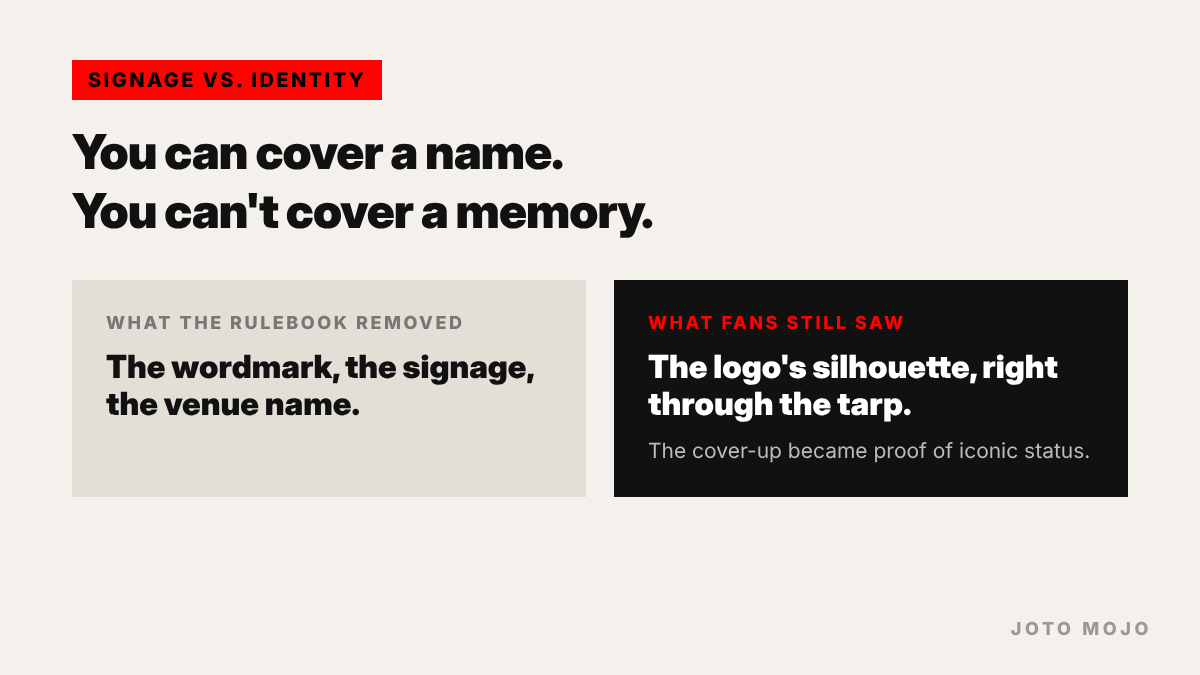
For the 2026 World Cup, FIFA required host venues to strip visible non-sponsor branding and adopt generic names. Levi's Stadium became the much less charismatic "San Francisco Bay Area Stadium," and the giant Levi's wordmark was covered up. The problem, for FIFA at least, was that the tarp still preserved the unmistakable outline of Levi's batwing logo.
Fans instantly recognized it. Instead of complaining or issuing one of those vanilla-flavored corporate statements people ignore, Levi's did something far smarter: it played along.
The brand updated its social profile image to mimic the covered-up version and joked about "the beautiful [redacted] stadium."
PR Fail
To be clear, the PR fail here is not Levi's.
The PR fail is FIFA's stubborn belief that branding is just a nameplate problem. There was plenty of time for better adjustments than that improv-attention-grabber-tarp-over-the-logo.
Cover the sign, remove the logo, rename the venue, done. But Levi's is not one of those brands. Levi's has the kind of visual identity that survives partial concealment, social screenshots, fan jokes, and very likely a fog machine.
So, what was meant to be a strict enforcement move became an accidental tribute.
FIFA tried to remove the branding. What it actually did was demonstrate, live and in public, that Levi's no longer needs to spell its name for people to know it is Levi's.
That is a fantastic outcome if you are Levi's. And a mildly hilarious one if you are the organization trying to disappear them.
Contrarian View
FIFA's real mistake was not enforcing the rule, it was assuming the rule would actually weaken the brand.
A contrarian move from FIFA would have been to accept what was already obvious: some brands are so embedded in the venue that trying to hide them only makes them more interesting. And on Levi's side, Bravo!
They did not fight the policy. They used it. That is the move.
A weaker company would have treated the cover-up like an insult. A stronger one looked at it and said, essentially: you can cover the name, but good luck covering the memory.
That reframes the story from "FIFA stripped Levi's branding from the stadium" to "Levi's is so recognizable that even the censorship worked as advertising."
Why It Blew Up
1. FIFA treated brand equity like removable signage.
Strong brands are not just words printed on surfaces. They are shapes, colors, associations, memory shortcuts, and years of repetition. Covering the letters does not help much when the audience can identify the silhouette from across the stadium.
2. Levi's understood the joke faster than FIFA understood the internet.
This is where Levi's won big. They did not resist. They did not whine. They did not act offended that global football bureaucracy had arrived. They recognized that the situation itself was funny, and they let the audience enjoy that with them.
3. The "cover-up" became proof of iconic status.
Most brands would hate being hidden. Levi's basically got handed a global branding stress test and passed it in public. If people can recognize your logo after someone tries to erase it, congratulations: you are no longer doing awareness marketing. You are doing mythology.
What FIFA Should've Done
If you are the side trying to control the environment, here is the lesson:
1. Know the difference between signage and identity.
Not every logo works the same way. Some brands live in the text. Others live in the shape.
2. Assume the audience is smarter than the rulebook.
If fans can recognize the brand instantly, pretending it has been effectively hidden just makes the enforcement look performative.
3. Never hand a good brand a free story.
Especially not a story where the takeaway is, "Look how famous this thing is, we can tell it is them even behind that ghostly sheet."
Now You Steal This
Before reacting to a brand restriction, naming conflict, or public limitation, ask:
- Are we actually being diminished, or being handed a stronger story?
- Is there a playful way to turn the restriction into proof of brand strength?
- Does the audience already understand the joke?
- Are we about to complain our way out of a branding win?
If yes, take a breath and drop your mouse right there. Stop with the offended statement drafting.
JOTO MOJO Time
FIFA brought the playbook. Levi's brought the self-awareness.
And that is why this worked so beautifully.
When an institution tries to reduce your visibility and accidentally proves your recognizability instead, you update the profile picture and let the audience finish the sentence for you.
That is not just good social media. That is brand command.
…and we'll tell you whether your brand would survive behind the sheets.
Because when your narrative is right, deals move faster. We've helped companies close their biggest clients in as little as 90 days.
Sources
- NBC Bay Area. (2026, June 13). Levi's embracing FIFA's World Cup stadium cover-up as a new branding opportunity.
- Creative Bloq. (2026, June 15). The World Cup forced this brand to hide its logo — then it backfired.
- talkSPORT. (2026, June 14). $1.3bn World Cup stadium finds genius loophole to bypass FIFA's strict branding rules.
No Comments Yet
Let us know what you think