

Sonos upgraded their app. Everyone wanted the old one back. The redesign promised a smooth experience, but basic features went missing.
There are updates. There are updates that annoy people.
And there are product updates that make customers wonder whether the expensive speakers already sitting in their homes have somehow been downgraded overnight.
That was Sonos.
Sonos makes premium wireless speakers designed to work together inside a home. Its app is the control center: customers use it to set up speakers, choose rooms, control their sound systems, and manage what plays where. For many customers, the app was the remote control for an audio system they had already spent thousands of dollars building.
On May 7, 2024, Sonos rolled out a huge app redesign. The company said the new app would be easier, faster, and better, preparing the community for a new generation of products. Two weeks later, Sonos would announce Ace, its first-ever headphones.
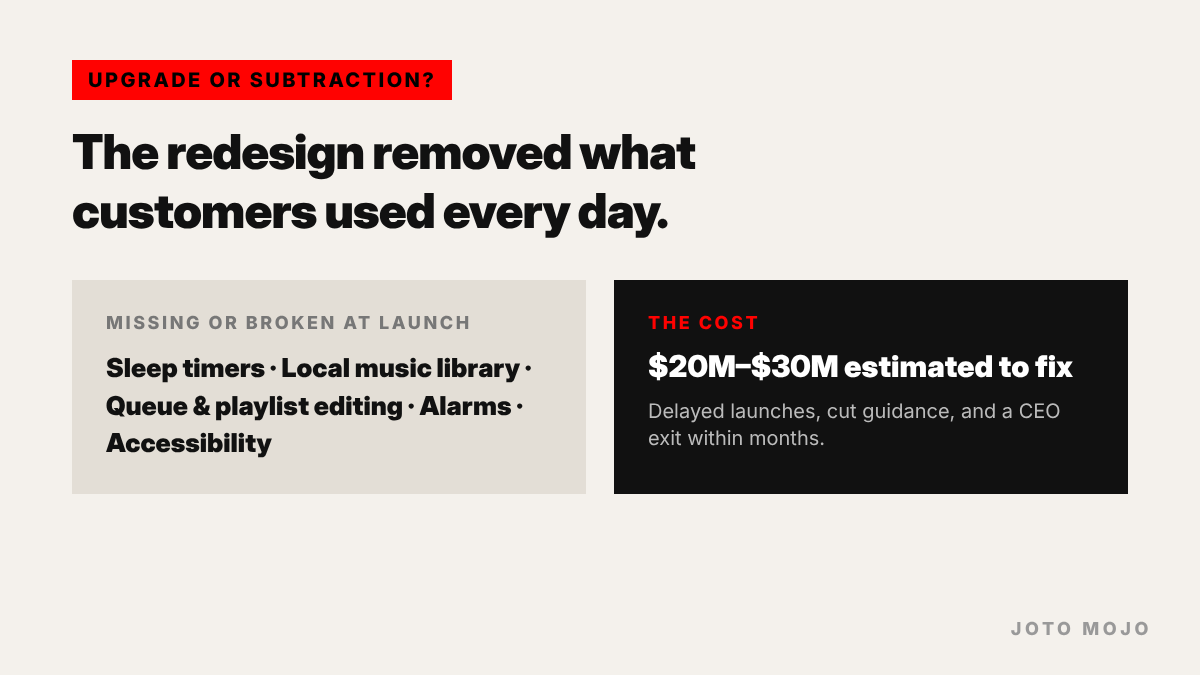
There was one problem. The new app was missing basic functions. Complaints included sleep timers, local music library access, playlist and queue editing, alarms, accessibility problems, and other bugs.
Sonos had launched the future. Customers wanted last night back.
By August, Sonos had cut its annual guidance, delayed two product launches, and estimated fixing the mess could cost $20 million to $30 million. By October, it was announcing tougher testing, a Customer Advisory Board, and a Quality Ombudsperson.
By January 2025... Patrick Spence was out as CEO.
PR Fail
The PR failure was not simply that the app had bugs. Sonos misunderstood what was changing.
Inside the company, this was a software redesign. Inside the customer's house, it was the control for products they already owned, used, and relied on.
When the app controlling your home removes a feature, the company has effectively reached back into a product you already paid for and literally changed what it can do.
Sonos marketed the redesign as progress. Users experienced a subtraction. An "upgrade" became a trust problem.
Contrarian View
Here's the unpopular idea: Sonos should have done absolutely nothing. At least to the app customers were already using.
Tech companies have developed a strange allergy to leaving things alone. Everything needs a redesign. A refresh. A new interface. A platform transformation.
Someone inevitably decides the perfectly functional button needs to move three screens over because innovation. But Sonos wasn't selling customers an app. It had already sold them the speakers. The app was basically the light switch.
Nobody wakes up thinking: you know what would make my house better? If someone completely redesigned all my light switches overnight.
Customers wanted to hit play. They wanted their alarms to go off. They wanted their playlists. They wanted the expensive speakers they bought yesterday to work exactly the same way tomorrow.
That is not resistance to innovation. That is the product promise.
The contrarian move would have been to leave the boring, functional app alone, and build the shiny new Sonos experience somewhere else. Call it Sonos Next. Make it optional.
Give it to the obsessive Sonos users first. The people with speakers in the kitchen, bedroom, garage, bathroom and probably one pointed at the dog. Those people would have found every missing feature within 48 hours.
Then Sonos could have said: "Love the old Sonos experience? Keep it. Want to see what we're building next? Come play."
Now you've turned your biggest critics into your beta testers. And your redesign into a community event instead of a hostage situation.
Because here's the contrarian rule: innovation does not always mean changing more things. Sometimes innovation is knowing what NOT to touch.
Sonos didn't need to move faster. It needed the institutional confidence to say: "This part works. Leave it the hell alone."
Not sexy. Not revolutionary. Probably wouldn't get a standing ovation at the product keynote. But it also wouldn't cost $20–$30 million to fix. And the CEO might still have had his job.
Why It Blew Up
1. The update changed something customers already owned.
Sonos was not asking people to buy a new product. It replaced the controls for an installed system.
If the new thing is optional, bugs are irritating. If it controls your house, bugs become personal.
2. Sonos underestimated "small" features.
Local libraries, alarms, sleep timers, and queue editing may look minor on a product roadmap. To someone who has used one every day for years, they are not minor.
Customers were angry because the "upgrade" interrupted what already worked.
3. The timing infected the next launch.
The new app arrived before Sonos announced Ace, its awaited move into headphones. Ace should have been a clean expansion story, like "Sonos leaves the living room and enters personal audio."
Instead, the new hardware arrived while existing customers were asking why they couldn't edit a playlist like they did since Windows 3.11.
What They Should've Done
1. Protect the experience that already works.
Keep the functional app available until the replacement reaches feature parity and stability. If rollback is impossible, that is not a launch-day discovery. It is a pre-launch warning.
2. Create a "nothing important breaks" gate.
Before release, list the tasks customers perform most often. Can they set up a speaker? Find music? Edit a queue? Use an alarm? Access local libraries? Use accessibility tools?
No green checkmarks, no big launch. A redesign succeeds because customers can still do what they bought the product to do. Not because the homepage looks cuter.
3. Separate the launches.
Do not attach a risky ecosystem rewrite to the same product cycle that needs customer goodwill.
Ace deserved its own spotlight. Instead, the new headphones arrived while existing customers were trying to figure out where Sonos had hidden the alarm clock (pun intended).
Now You Steal This
Before replacing an app, platform, or portal customers already rely on, ask:
- What existing behavior are we breaking?
- Which "small" features would our most loyal users riot over?
- Can customers opt out?
- Is it possible to roll back?
- Are we launching because it is ready or because the Project Manager said so?
Always, above all: are we improving the product?
JOTO MOJO Time
Sonos eventually apologized, restored features, changed its testing practices, and created new quality safeguards.
It was also an extremely expensive way to discover something simple: a redesign does not mean an automatic upgrade. Sometimes the most innovative thing a company can do is leave the working part alone until the replacement actually works.
Sonos wanted a platform ready for its next generation. Its customers wanted the speakers they had already bought to play music and alarms like their old radios did.
The Anti-PR move was to protect trust first, release the headphones, make sure the community was happy, and modernize afterwards. Customers can forgive a new feature that does not work. They are not accepting apologies when you remotely remove the old one that did.
…and we'll tell you whether your next launch will be a hit or a disaster for your customer support hotline.
Because when your narrative is right, deals move faster. We've helped companies close their biggest clients in as little as 90 days.
Sources
- Sonos, Inc. (2024, May 21). Sonos makes its highly-anticipated headphones debut with Sonos Ace.
- Purdy, K. (2024, July 25). Sonos CEO apologizes for botched app redesign, promises month-by-month updates. Ars Technica.
- Harding, S. (2024, August 8). Sonos' $30M app fail is cautionary tale against rushing unnecessary updates. Ars Technica.
- Welch, C. (2025, January 13). Sonos CEO Patrick Spence steps down after disastrous app launch. The Verge.
No Comments Yet
Let us know what you think