
Humane, Inc. sold the future. The present sent it back. They promised the device after the smartphone. They just forgot to tell the smartphone about it.
There are ambitious product launches. There are moonshot product launches.
And there are product launches that arrive wrapped in the language of cultural revolution, only to be reviewed like a warm, confused accessory with personality issues.
That was Humane, Inc.'s AI Pin.
The company launched their AI Pin as a wearable device meant to free people from their phones with an ambitious promise: no more screen addiction. No more doomscrolling. No more glowing rectangle running your emotional life.
Just a clip to your shirt that combined AI, personal assistance, and high-end computing for your needs. A more human, post-phone future.
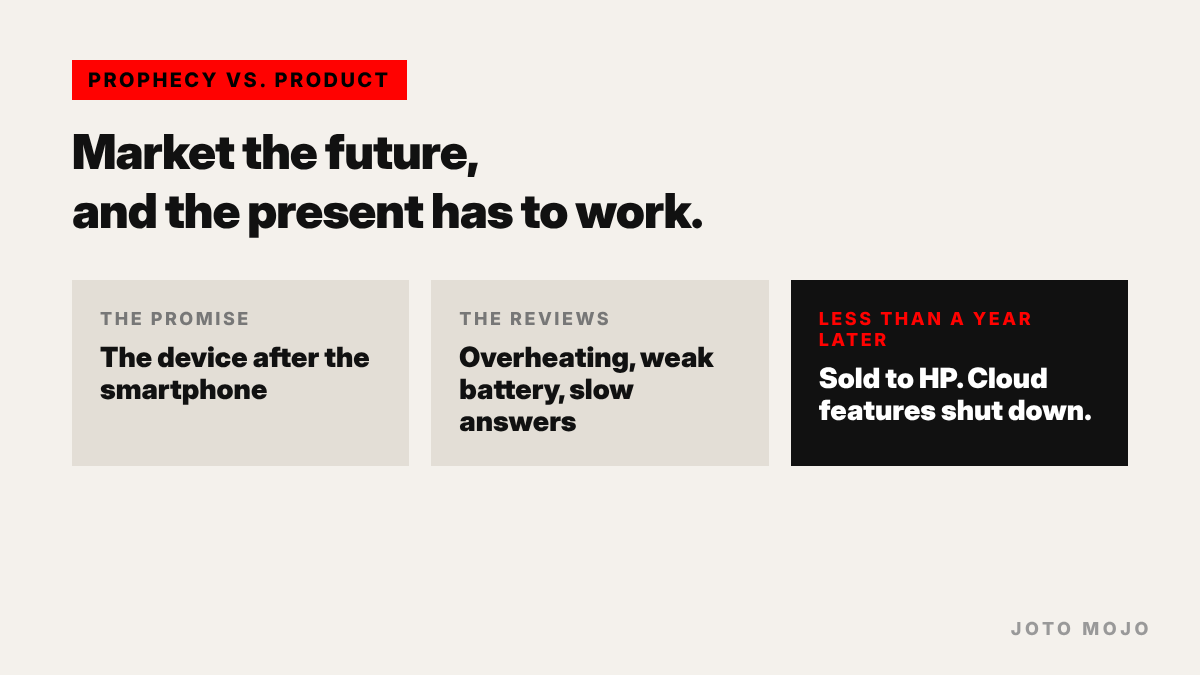
Customers and reviewers got their hands on it and... Well: AI Pin started overheating, had a weak (not week-long) battery life, slow responses, and what matters most: extremely limited everyday usefulness. Which is brutal when you have marketed yourself not as a first-generation experiment, but as the future arriving in public.
PR Fail
First-generation hardware is often imperfect, right? That is survivable. That is called "shipping something ambitious before physics and battery chemistry have fully agreed to cooperate."
The real PR fail was selling the device like a fully formed cultural shift before it had earned the right to survive an ordinary weekday. It barely survived a beta stage.
That is the collapse. Not that the Pin had flaws. But that Humane, Inc. asked the public to greet those flaws as the arrival of a new era.
Which is how you turn a product launch into a trust/PR problem.
Contrarian View
Humane, Inc.'s mistake was not a flawed device.
The Pin could have survived being flawed. What it could not survive was being marketed like prophecy. A mix of the movies Gattaca and Her onto your jacket, without Ethan Hawke or Joaquin Phoenix.
A smarter launch would have been radically smaller. Not "this replaces the smartphone." Not "this changes computing." Not "the future is finally here with a cool magnetic clip."
Something like: "This is an ambitious first step. It is for early adopters. It is a glimpse of where personal computing might go, not the finishing line."
The public can forgive unfinished. What it does not forgive is messianic language attached to a beta experience.
The most disruptive thing the company could have done was not to announce a revolution. It was to act like it understood revolutions usually arrive after awkward prototypes.
Why It Blew Up
1. The message was much bigger than the product.
Humane sold a post-phone future. The market got a device that often made the phone in your pocket feel even more competent.
2. The reviews hardened the narrative immediately.
Once the Pin became "that overhyped AI gadget that barely works," the story was no longer about possibility. It was about delusion with industrial design.
3. The ending made the whole launch look even harsher in retrospect.
When the company was sold to HP and shut down the AI Pin's cloud features less than a year after launch, the product stopped feeling like a bold miss and started feeling like an expensive trust exercise that customers accidentally funded.
What They Should've Done
1. Market the product as a first step, not the second coming.
If the device is still early, say it is early. "Ambitious prototype for early adopters" is survivable. "This replaces the smartphone" is how you accidentally book yourself a public humiliation tour.
2. Let usefulness win before philosophy does.
Humane, Inc. sold an idea before it proved a habit. Beautiful vision is nice. But if people cannot get through an ordinary day with the thing, maybe do not open with a manifesto about the future of computing.
3. Earn the revolution in smaller sentences.
You do not have to whisper. But you do have to leave room for reality. The smarter move would have been to understate the prophecy, overdeliver the experience, and let users decide whether they were holding the future or just a very expensive conversation starter.
Now You Steal This
Before launching any "future of technology" product, ask:
- Are we selling what the product is, or what we hope it becomes?
- If reviewers use this in normal life for three days, do we survive?
- Are we introducing a first step, or pretending we have already crossed the finish line?
- If the product disappoints, will the language around it make the disappointment feel ordinary or humiliating?
If the answer to that last one is "humiliating, but sleek," rewrite the deck. Or the product code lines. Or both! Both, please.
JOTO MOJO Time
Humane, Inc. did not become a PR fail because the AI Pin was weird. Weird can win. It became a PR fail because the company tried to skip the awkward part of innovation: proving the thing is useful.
That is what made the whole story so (un)satisfying to the public. Not just that the product struggled. Not just that the reviews were brutal. But that the company had reached for "this is the next computing platform" and landed on "please keep your phone nearby."
If you market the future, the present must work. Not beautifully in a keynote. Not poetically in a founder interview. Actually. Daily. In public.
Humane sold the future. The present sent it back. The past made it anecdotal enough.
…and we'll tell you whether your next launch is building real momentum or just wrapping a prototype in prophecy.
Because when your narrative is right, deals move faster. We've helped companies close their biggest clients in as little as 90 days.
Sources
- Peters, J. (2025, February 18). Humane is shutting down the AI Pin and selling its remnants to HP. The Verge.
- Peters, J. (2024, October 23). Humane slashes the price of its AI Pin after weak sales. The Verge.
- WIRED. (2025). The Humane AI Pin has already been brought back to life.
No Comments Yet
Let us know what you think