
PwC's whole brand is "nothing gets past us." Then an envelope got past them.
There are mistakes, and then there are mistakes that feel like satire written by someone with a grudge.
PwC was not at the Oscars to be interesting. PwC was there to be invisible in the most reassuring way possible — the human equivalent of a locked drawer. Their role was simple: hold the envelopes, protect the result, do not become part of the entertainment.
And then, with breathtaking efficiency, they became the entertainment.
PR Fail
In 2017, Warren Beatty and Faye Dunaway were handed the wrong envelope for Best Picture. La La Land was announced. People began thanking agents, spouses, and possibly God. Then came the correction: the real winner was Moonlight.
Which is already objectively painful.
But the real PR masterpiece here was the brand symmetry of it all: PwC, a company whose entire public personality is precision, managed to create the least precise moment in Oscar history.
That is not a mistake. That is irony wearing a lanyard.
Why This Was Such a Disaster
Because the error wasn't random. It attacked the exact thing PwC was there to represent.
If a snack brand fumbles an awards envelope, that's funny.
If an accounting firm fumbles an awards envelope, it raises larger spiritual questions.
Their brand promise was not glamour. It was control.
Not sparkle. Systems.
Not chaos. Checklists.
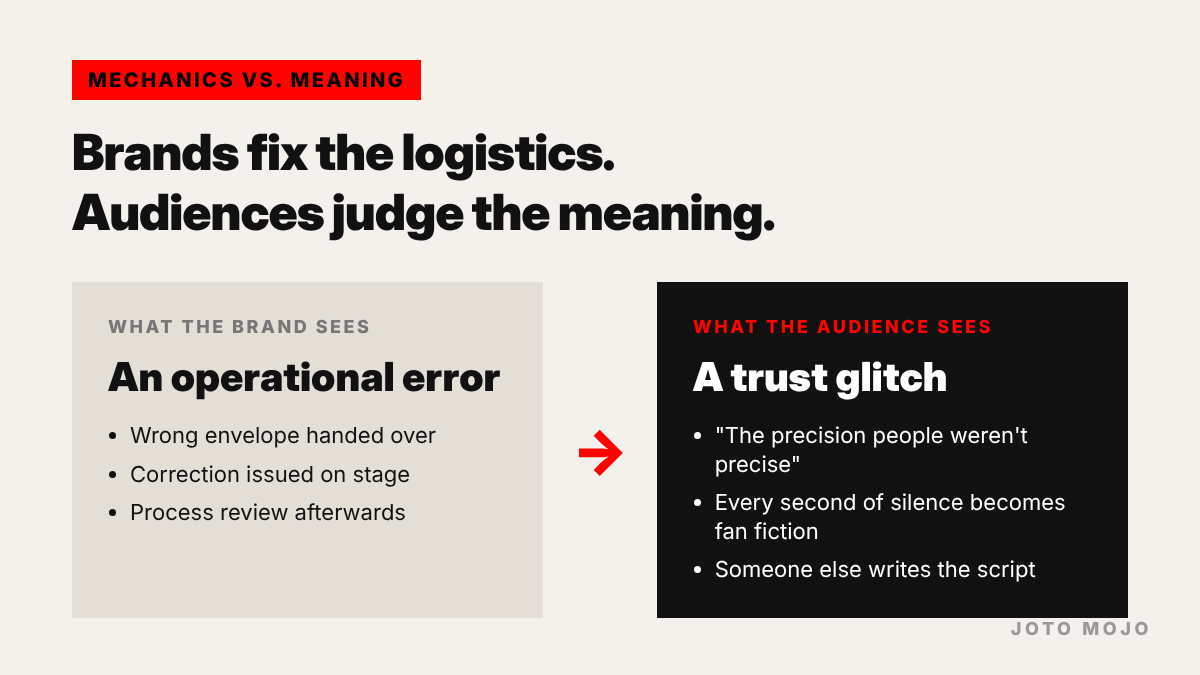
So when the wrong envelope appeared onstage, the public didn't just see an event glitch. They saw a trust glitch.
And trust, inconveniently, is harder to reissue than stationery.
What Really Went Wrong
1. The failure contradicted the brand.
This wasn't "oops." This was a live demonstration of the exact outcome they are hired to prevent.
2. The correction lagged.
In a situation like this, every second of hesitation becomes fan fiction, and the internet is always happy to fill in the blanks with whatever is funniest and worst.
3. The moment was allowed to become symbolic.
Once the public decides your mistake "says something," you are no longer fixing an operational problem. You are now in a values crisis dressed as logistics.
That is where a lot of smart companies get caught. They keep responding to the mechanics after the audience has moved on to meaning.
The Contrarian Take: This Might Have Been PwC's Most Valuable Brand Moment
The real failure wasn't the envelope — it was the absence of showmanship from PwC's comms machine. This is a firm that handles billion-dollar crises, yet when handed a global stage, they defaulted to corporate stooge mode instead of doing what great PR does: turn the mistake into the story.
Imagine this instead: within minutes, they step forward, not with a sterile statement, but with a live, authoritative breakdown: "We got the envelope wrong. Here's exactly how it happened—and here's how we fix it."
Then they lean in: a rapid-fire media tour, a visual "How the Oscars Went Wrong" diagram circulating online, and a next-day headline they own: "How PwC Fixed the Most Public Mistake in Oscar History."
That's showmanship. That's command.
Because the real flex in PR isn't avoiding failure, it's taking a failure the entire world is watching and turning it into a masterclass in control. Instead, they tried to disappear, and in doing so, let everyone else write the script.
The Lesson
When your reputation is built on being calm, careful, and impossible to rattle, your mistakes do not read as ordinary mistakes.
They read as spoilers.
That's the real issue here. The envelope was the plot device. The actual story was: the adults in charge briefly looked like they had misplaced the adults in charge.
And that's why this moment stuck.
Not because it was messy.
Because it was poetically messy.
Use your mistakes to win and gain more credibility and public recognition.
Steal This
Before any launch, live event, announcement, or high-visibility media moment, ask:
- What is the one mistake that would look especially ridiculous for us?
- If it happens, who has authority to interrupt immediately?
- What is our one-sentence admission?
- Can we explain the fix without using the phrase "moving forward"?
If not, congratulations: you are one branded mishap away from becoming content.
…and we'll tell you whether your next campaign is built to land or built to become the theme of our next newsletter.
Because when your narrative is right, deals move faster. We've helped companies close their biggest clients in as little as 90 days.

WinMagic Exposes the Wrong Identity Tax: Why Cybersecurity Costs Rise While Security Fails

Good Employers Keep Choosing the Wrong PBM Because They Start With the Wrong Metrics
No Comments Yet
Let us know what you think