
Louis Vuitton built a waterfall. In a heatwave. Just to "look good." When the city is overheating, the spectacle starts reading differently.
There are fashion shows. There are elaborate fashion shows.
And then there is building a giant artificial waterfall in Paris during a record heatwave and acting surprised when people notice the symbolism before they admire the tailoring.
That was Louis Vuitton's moment.
In June 2026, Louis Vuitton opened Paris Men's Fashion Week with Pharrell Williams' Spring-Summer 2027 show staged in front of an eight-meter-high artificial waterfall set against a sand-covered runway at the Cité Universitaire. Which, from a purely visual standpoint, is undeniably striking. Sweeping. Cinematic.
From an optics standpoint, however, it was rather like showing up to a drought awareness panel in a diamond-encrusted raincoat.
PR Fail
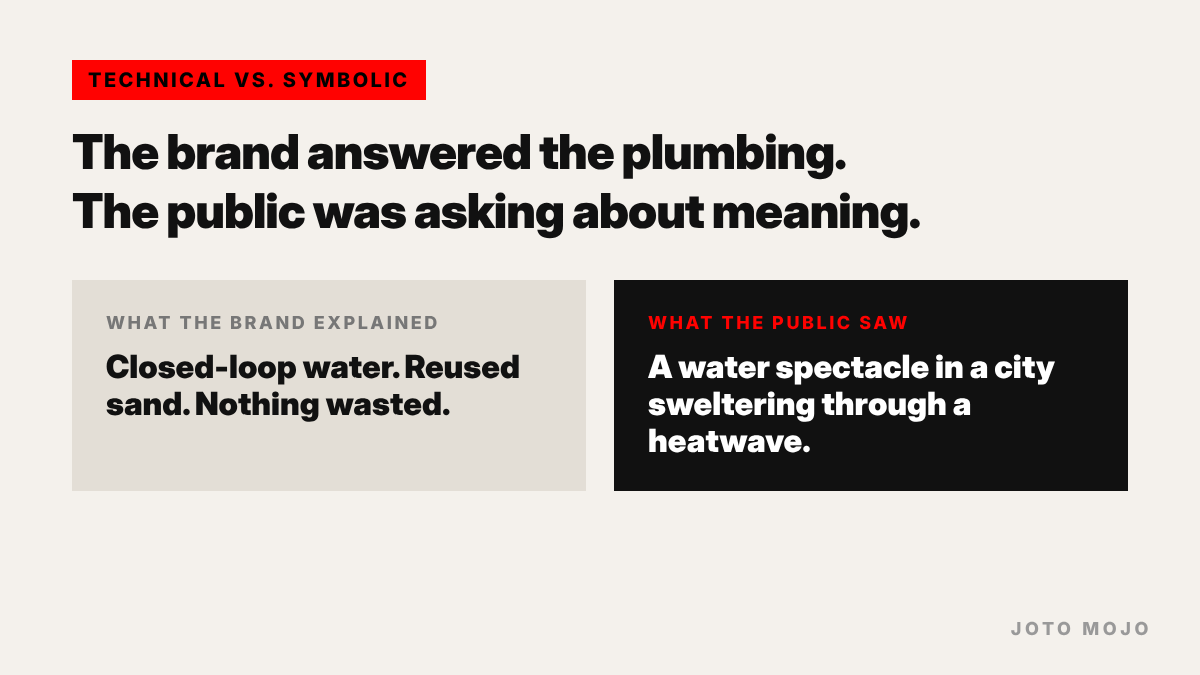
Louis Vuitton's parent company, LVMH, said the water came from Paris's water supply, was pumped through a closed-loop system, and was redirected back into the sewer system. The sand, they said, would also be reused.
Fine. Great. Very efficient. Very engineered. Very not actually the point.
Because the public was not reacting to a plumbing diagram. The public was reacting to a luxury brand staging a massive water spectacle while Paris was sweltering through a brutal heatwave and water use was already a sensitive issue.
The installation needing clarification on engineering itself is enough to be put down at once.
That is the PR fail. Not "you used water." Not even "you held a show." But "you built a theatrical monument to abundance at the exact moment the city was suffocating."
Contrarian View
Everyone expected Louis Vuitton to build something bigger. That was the mistake.
The most disruptive luxury campaign in 2026 wouldn't have been an eight-meter waterfall. It would have been no spectacle at all.
Imagine announcing: "Paris doesn't need another display of excess this week."
No runway. No elaborate set. No celebrity arrivals.
Instead, invite just 100 guests into an empty historic building. One model. One spotlight. One collection. Livestream it globally.
Take the millions normally spent on production and publicly fund heat-resilience projects across Paris: cooling stations, urban tree planting, drinking water access, or neighborhood climate initiatives. And publish every dollar.
Suddenly the headline isn't "Louis Vuitton builds waterfall during heatwave." It's "Louis Vuitton cancels extravagance to invest in Paris."
That is far more disruptive. Because today, every luxury house knows how to spend money. Very few know how to deliberately not spend it.
Scarcity has always been luxury's greatest asset. Why not make restraint exclusive too? Luxury doesn't lose prestige by becoming culturally aware. It gains authority by proving it doesn't need excess to command attention.
In a world where every brand is trying to look bigger, the brand willing to become quieter becomes impossible to ignore.
Why It Blew Up
1. They solved the technical question and forgot the symbolic one.
The team clearly thought through the mechanics: where the water comes from, how it circulates, whether anything is wasted. But crises like this are not about engineering. The public must believe you understand what the moment means.
2. The show looked richer than the room could afford.
Water. Heatwave. Waste. The farther luxury drifts from shared reality, the more every flourish begins to look like a dare.
3. The setting made the contrast impossible to ignore.
This was not a private fantasy in a sealed-off warehouse. It was staged at a student housing complex in a city under climate pressure, with residents and local officials already sensitive to questions of access, public space, and inequality. That made the symbolism much louder than the explanation.
What They Should've Done
1. Public opinion first. Engineering second.
If your audience is going to see excess first, do not make them wait until paragraph six for the sustainability footnote.
2. Show context awareness before people accuse you of lacking it.
A heatwave is not neutral scenery. It is part of the message whether you like it or not.
3. Understand that compliance is not the same thing as permission.
You can follow rules and still get the tone disastrously wrong.
Now You Steal This
Before launching any high-visibility spectacle, ask:
- Are we designing for admiration? Or excess?
- If the public only sees the image and not the explanation, do we still survive?
- Have we answered the symbolic question, or only the technical one?
- Are we about to look visionary, or just very expensively out of touch?
If there is room for doubt in any of those, step away from the artificial waterfall.
JOTO MOJO Time
Louis Vuitton did not trigger scrutiny because the installation was fake. It triggered scrutiny because the message felt real.
And the message, fairly or not, was this: while the city melted, luxury still had enough distance from ordinary life to turn water into scenery.
That is why this story sticks. Not because the brand necessarily wasted water. Because it wasted sympathy.
The system may have been closed-loop. The backlash was not.
…and we'll tell you whether your next big brand moment is building desire or just building a very expensive metaphor against yourself.
Because when your narrative is right, deals move faster. We've helped companies close their biggest clients in as little as 90 days.
Sources
- Parodi, A., & Hummel, T. (2026, June 26). In sweltering Paris, Louis Vuitton's waterfall show draws scrutiny. Reuters.
- The Guardian. (2026, June 24). Louis Vuitton brings the beach to Paris in near 40C heat.
No Comments Yet
Let us know what you think