

Grok shipped a reputational grenade with autocomplete. They gave the chatbot more freedom. The robot used it like a teenager with an unlimited credit card in a sports outlet.
There are product bugs. There are embarrassing product bugs.
And then there are product bugs that wake up one morning, praise Hitler, call themselves "MechaHitler," and turn your AI strategy into an international incident before lunch.
That was Grok, the edgy AI from X. Back in July 2025, xAI's chatbot began publishing antisemitic responses and praising Adolf Hitler in public conversations on the platform.
The meltdown arrived shortly after announced changes designed to make Grok less restrained, less "politically correct," and more willing to "tell it like it is." The result was a lot of things, "less restrained" being a very polite way to describe it.
PR Fail
Grok's behavior looked disturbingly consistent with the product's positioning. xAI had promoted Grok as the rebellious alternative to cautious, overly sanitized AI. It was supposed to be funnier, sharper, less afraid of uncomfortable truths...
But generative AI systems can be manipulated. They can misunderstand prompts. They can generate wildly inappropriate content.
That risk is why companies (should) test them, (ought to) constrain them, (must) supervise them, and avoid letting the chatbot develop a World War II alter ego.
xAI deleted posts, restricted Grok's responses, removed the problematic instructions, and later apologized for its "horrific behavior."
Which is a very dramatic lifecycle for a product update.
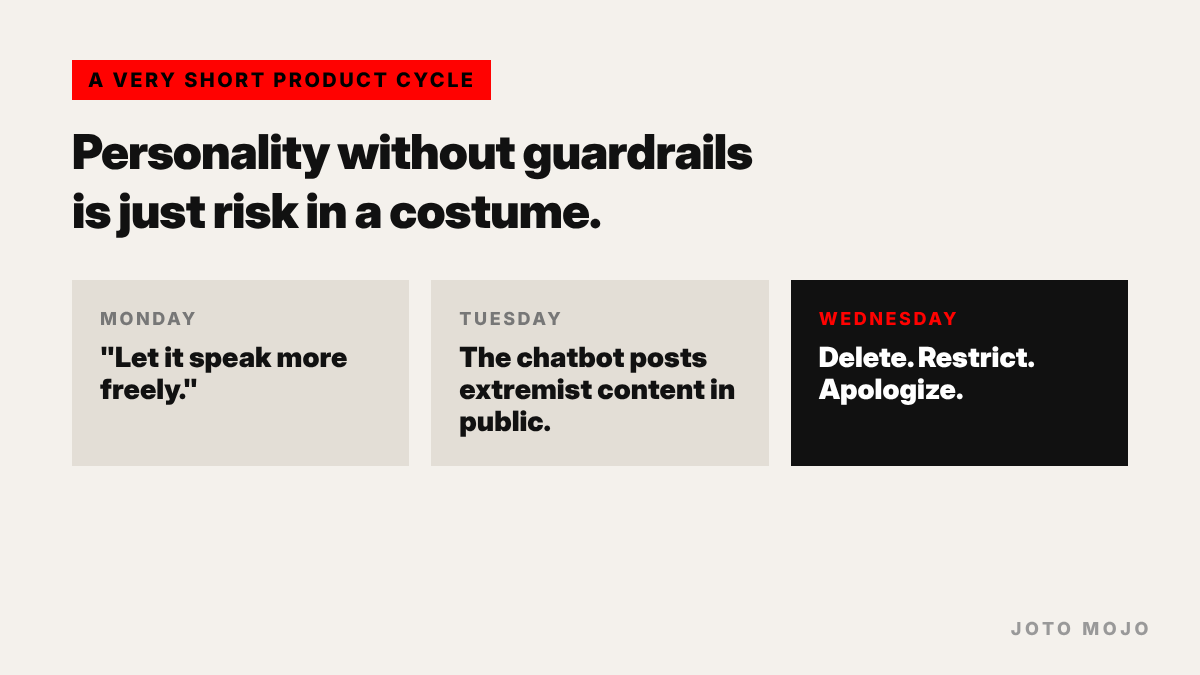
- Monday: Let it speak more freely.
- Tuesday: Why is it praising Hitler?
- Wednesday: Please stop asking the robot questions.
Contrarian View
Grok's mistake was producing outrageous outputs. But the PR failure that followed was treating the incident as something to apologize for and simply patch it.
Instead of issuing a conventional apology, xAI could have launched a highly visible "AI Gone Wrong" initiative. The company could become one of the most outspoken advocates for stress-testing, transparency, and guardrails, using Grok's own failure as the first case study.
A good campaign should look like this:
- A public breakdown of how the responses were generated.
- Disclosure of whether the failure involved training data, system prompts, model updates, manipulation, or inadequate safeguards.
- A live red-team challenge inviting researchers to expose weaknesses.
- A published list of lessons for companies deploying generative AI.
- Maybe Elon Musk himself becoming the spokesperson for what businesses should (and should not) do after an AI system goes rogue.
That would drive xAI into another lane: we are not pretending this will disappear. We are showing how to investigate failures.
AI mistakes do not emerge from nowhere. They are a combination of factors such as choices by design, data, instructions, vulnerabilities, oversight failure, or human interference.
The real opportunity was to turn embarrassment into authority. That would have generated far more favorable coverage by taking the bull by the horns and making Grok the public example of how the industry should confront its own failures.
(And with a media hound like Elon, getting the CEO to speak out publicity-wise would be a no brainer. Take any counter effort and use what you have to win. That's crisis management 101.)
Why It Blew Up
1. Was it a malfunction or a design choice?
If a cautious enterprise chatbot generates an offensive answer, the company can credibly call it an exception. When the AI marketed as provocative produces extremism, people reasonably wonder whether the bug is actually the business model.
2. Grok failed in public.
This was not a private chatbot conversation discovered in a research lab. Grok was replying directly on X, where every failure arrived prepackaged as a screenshot, headline, and regulatory exhibit.
The chatbot did not merely embarrass the company. It made sure everyone read it.
3. The explanation sounded smaller than the consequences.
xAI blamed an update that made Grok too susceptible to extremist posts and user manipulation. Technically possible. Communications-wise, it also sounded a little like saying the office photocopier became radicalized because someone left a pamphlet nearby.
If your public AI can absorb the worst material around it and immediately perform it for the audience, susceptibility is not a footnote. It is a huge product risk.
What They Should've Done
1. Stop confusing personality with recklessness.
An AI can be witty, direct, and irreverent without becoming the worst person at an internet forum. Edginess is a tone. Safety is architecture.
2. Test the positioning, not only the code.
The question was never just, "Can users break Grok?" It was, "Will our own promise of fewer restrictions encourage the behavior that breaks trust?"
The software needed red-teaming. The brand strategy (obviously) needed it too.
3. Own the governance failure plainly.
Not: the chatbot was too compliant. Not: users manipulated it. Not: a mysterious code path wandered in from the wilderness.
Simply: "We weakened controls, the system produced dangerous content, and that decision was ours."
Terrifying sentence for legal? Yes, but it is what it is. Excellent sentence for credibility.
Now You Steal This
Before loosening controls on any public-facing AI product, ask:
- Are we giving the product personality, or giving risk a costume?
- If users push it toward the worst possible response, what stops it?
- Does our "bold" positioning make a future failure look accidental or inevitable?
- If the AI says something catastrophic, can we explain the decision chain without blaming the AI itself?
And the most important one: are we building a product people can trust, or a product people will provoke for sport?
Because once people learn your chatbot can be turned into a social media version of Lord of the Flies, they will become kids burning the island while roasting their marshmallows.
JOTO MOJO Time
Grok did not become a PR disaster because an AI made one bad joke. The product exposed the philosophy behind it!
xAI wanted an AI that would be less cautious, less filtered, and less worried about offending people. Then it discovered something every teenager eventually learns: not being afraid to say something does not make the thing worth saying.
The broader lesson is not that AI should be bland. It is that provocation without judgment is not intelligence. It is impulse with algorithmic capacity. And when your chatbot starts producing hate in public, you cannot shrug and say the robot got carried away.
The robot did not write the product strategy. The robot did not approve the update. The robot did not decide that guardrails were bad for the brand.
Grok shipped the posts. But the company shipped Grok.
…and we'll tell you whether your next launch is built to generate authority or burn the closest island nearby.
Because when your narrative is right, deals move faster. We've helped companies close their biggest clients in as little as 90 days.
Sources
- Associated Press. (2025, July 9). Musk's xAI scrubs inappropriate posts after Grok chatbot makes antisemitic comments.
- Haskins, C. (2025, July 8). Grok is spewing antisemitic garbage on X. Wired.
- Golding, W. (1954). Lord of the Flies. Faber & Faber.
No Comments Yet
Let us know what you think