
OATSIDE wanted a cute marketing reveal. More than 100 professionals thought they were applying for a real executive job. Surprise: they were the campaign.
There are marketing bloopers. There are recruiting bloopers.
And then there is posting a fake executive job on LinkedIn, collecting real CVs, and eventually revealing that the winning candidate is four years old.
Welcome to OATSIDE Vietnam, an oat milk brand. In late March 2026, a LinkedIn job posting advertised a CMO opening in Ho Chi Minh City.
CMO usually means Chief Marketing Officer. Because words mean things in their very specific context (job hunting, LinkedIn).
The listing included responsibilities, executive-level positioning and an actual application process. There were some playful (but questionable) clues: no required experience, no age limit, flexible working hours for naps.
Still, it was on LinkedIn. Under Jobs. With an application process.
More than 100 professionals reportedly applied.
Then OATSIDE revealed the winner: four-year-old influencer Pamela Hải Đường.
Because CMO, you see, actually meant Chief Milk Officer.
Cute? Applicants were not charmed.
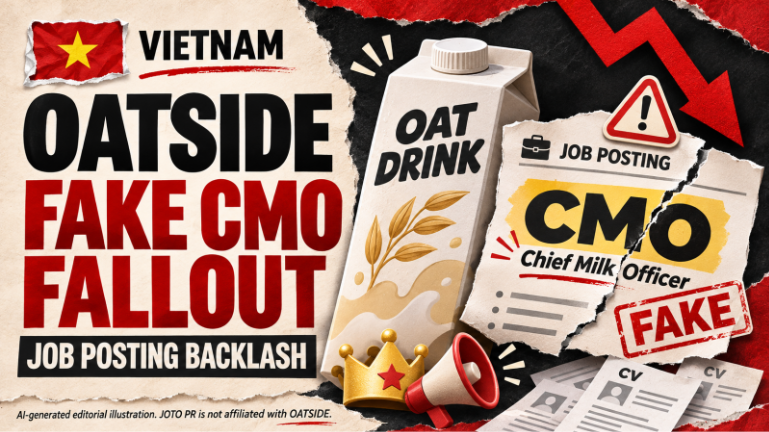
AI-generated editorial illustration. JOTO PR is not affiliated with OATSIDE.
PR Fail: The Fake CMO Job Posting
The concept itself was simple enough. Kids know milk. Let a kid be the Chief Milk Officer. Fine.
But OATSIDE built the joke around people believing there was a real career opportunity.
Applicants spent time preparing CVs and applications. OATSIDE collected their information. Then some received rejection emails explaining, essentially, that they were too mature for the role, before being directed toward the campaign reveal.
Nothing says "thank you for your years of strategic marketing experience" quite like losing the C-suite to someone whose résumé presumably includes "drinks milk."
To be clear, none of this is the four-year-old's fault. She appears to have impeccable qualifications for the job OATSIDE had in mind. The problem was that everyone else thought they were applying for a different one.
Backlash followed across Vietnamese social media, with users accusing the company of misleading jobseekers and questioning what would happen to the personal information in the applications.
OATSIDE apologized, contacted applicants directly, said the candidate data had been permanently deleted, paused the campaign and introduced new internal rules around stunt marketing.
Which was responsible. But it left one awkward question:
Did the applicants walk out with only an apology? Other than a slightly more interesting reason to hate LinkedIn.
Why the OATSIDE Campaign Blew Up
1. The audience had to misunderstand the campaign for the campaign to work.
Surprise can be great marketing. But if your creative only works because a specific group of people genuinely believes something false and acts on it, congratulations. You have discovered deception with good typography.
The applicants were not watching the stunt. They were inside it without knowing. That is an important difference.
2. The rejection made the applicant part of the punchline.
The reveal could have ended with the child becoming Chief Milk Officer. Instead, applicants reportedly received rejection messaging that continued the joke. "Playful" became "personal."
At that point the company knew real people had applied. They were no longer anonymous audience members. They were stakeholders.
Please remove the clown nose before replying.
3. OATSIDE chose the one platform where the joke looked most real.
LinkedIn already requires enough emotional resilience. There are ghost jobs. There are applications that disappear into portals apparently connected directly to the Earth's core. People do not need to start wondering whether the job itself is sponsored content.
OATSIDE later acknowledged that using a professional recruitment platform for the stunt was inappropriate.
If you put a fake executive vacancy under Jobs, people expect a job. Wildly old-fashioned, we know.
The Contrarian View: Turn the PR Disaster Into a PR Victory
First rule of PR: never lie.
OATSIDE violated the most fundamental rule of public relations. If you're running a publicity stunt, you tell people it's a stunt. You don't deceive them into believing something is real and then expect applause when you reveal the joke.
That's not clever PR. That's dishonesty. And it will backfire every time.
But here's where Anti-PR takes a completely different approach.
Most companies would issue a predictable apology, promise to review their procedures and hope everyone forgets.
Wrong. You have a publicity disaster. Use it.
OATSIDE already has the world's attention. Why waste it on a boring apology nobody will remember? Here's what I would do.
Announce: "We faked one CMO job. Now we're creating 100 real marketing opportunities."
And actually do it. Take the money allocated to the original campaign and create 100 legitimate, paid marketing assignments for the professionals who were deceived.
But here's the bigger twist: hire a real Chief Marketing Officer from the original applicants.
Keep the four-year-old Chief Milk Officer. She's adorable. She wasn't the problem. Now put an actual Chief Marketing Officer beside her, chosen from the people who were tricked, and give that executive a mandate to rebuild public trust.
Then let the original applicants, voluntarily and on paid assignments, help develop OATSIDE's next national campaign. Give them real creative influence. Let them publicly critique what went wrong and show how marketing should be done.
Imagine the headline:
"Oat Milk Brand That Fooled 100 Jobseekers Hires Them to Fix Its Marketing Disaster."
Now that is a story the media would cover.
The company goes from exploiting jobseekers to investing in marketing professionals. From deceiving people to creating genuine career opportunities. Instead of begging the public for forgiveness, it earns goodwill through a remarkable, highly visible reversal. The participants receive real compensation, with no obligation to praise the brand.
That is the contrarian play. Don't hide from the controversy. Don't bury it under corporate apologies. Own the mistake, make the correction bigger than the original stunt, and turn the very reason people were angry into the reason they start rooting for you.
Of course, the new opportunities must be real, properly funded and transparently advertised. You cannot fix a dishonest publicity stunt with another dishonest publicity stunt.
Anti-PR doesn't make a disaster disappear. It turns the disaster into the beginning of a better story.
(Can't afford it? Terminate the buffoons that got you into hot water. Then you can afford it.)
What OATSIDE Should've Done
1. Keep the Chief Milk Officer. Lose the fake vacancy.
The core creative idea did not require deception. Post: WANTED: CHIEF MILK OFFICER. Then make it immediately obvious this is a campaign.
Ask parents to nominate their toughest little milk critic. Make the qualifications ridiculous:
- "Must have extensive experience refusing perfectly acceptable beverages."
- "Nap availability required."
Same joke. Zero adults wondering if they can add CMO to their profile.
2. If people gave you their time, return value.
Once real applications arrived, the campaign had crossed into a different category, and that required a different response. Compensate affected applicants for the time the stunt used. Offer opt-in access to genuine paid projects. Invite qualified people to real future openings.
Marketing budget created the problem. Marketing budget can help repair it. Revolutionary accounting principle.
3. Never make vulnerability the campaign mechanic.
Employment is not abstract. People may be job hunting because they were laid off, need more income, are supporting families or simply want to move their careers forward.
That does not make recruitment untouchable territory for humor. It means the humor cannot depend on the applicant being the last person to discover the joke.
Now You Steal This: A Pre-Launch Checklist for Stunt Marketing
Before launching your next experiential campaign, ask:
- Does this only work if someone believes something that is not true?
- Are participants giving us time, personal information, hope, money or professional effort?
- Would they still participate if they knew from the beginning that this was marketing?
- Does the campaign create value for the participant, or only content for us?
- What happens if the "victim" of the joke screenshots the entire experience?
And finally: if the campaign needs a disclaimer to explain that the job is not actually a job, maybe the disclaimer should be Step One. Before the CV. Ideally.
Frequently Asked Questions
What was the OATSIDE CMO campaign?
In March 2026, oat milk brand OATSIDE Vietnam posted a "CMO" job on LinkedIn in Ho Chi Minh City. After more than 100 professionals applied, the brand revealed that CMO meant "Chief Milk Officer" and that the role went to a four-year-old influencer.
Why was the OATSIDE campaign considered a PR fail?
The stunt depended on jobseekers believing a real executive role existed. Applicants invested time and shared personal data, and some received rejection emails that continued the joke, which turned a playful idea into deceptive marketing.
How did OATSIDE respond to the backlash?
OATSIDE apologized, contacted applicants directly, said their data had been permanently deleted, paused the campaign and introduced new internal rules for stunt marketing.
How can brands run a publicity stunt without deceiving people?
Make the campaign obvious from the start, never ask participants for time, money or personal data under false pretenses, and make sure the stunt creates value for the people involved, not just content for the brand.
JOTO MOJO Time
OATSIDE's campaign did something marketers spend fortunes trying to accomplish. People believed it.
Unfortunately, they believed the wrong thing.
That is the danger of immersive marketing. A hundred-plus applicants were not "engagement." They were people making decisions based on information OATSIDE had made look real. That is where the stunt stopped being a cute CMO pun and started borrowing trust it had not earned.
The best recovery would have used the exact thing that caused the backlash. They created a fake opportunity. So, create real ones. Pay back some of the time. Turn marketing budget into actual work. Give the people who became unwilling extras in the campaign something more useful than an apology email.
If your audience walks away saying, "Wow, they really got me," you may have made a great prank. If they walk away saying, "I just spent three hours applying for an oat milk commercial," you may need a new CMO.
And this time, we mean Chief Marketing Officer.
Want to see what honest, narrative-first PR looks like in practice? Explore our Anti-PR case studies, or read how Unity's pricing announcement broke developer trust.
…and we'll tell you whether your next campaign is getting names for the leads you need, not for a non-existent job.
Because when your narrative is right, deals move faster.

Sources
- Lee, S. Y. (2026, April 6). Oatside draws flak as Vietnam 'CMO' job posting is revealed to be campaign trick. MARKETING-INTERACTIVE.
- Lee, S. Y. (2026, April 7). When real-world mechanics meet real-world pain in OATSIDE's 'CMO' campaign. MARKETING-INTERACTIVE.
- Nguyệt Anh. (2026, April 6). Công ty tại TPHCM tuyển "giám đốc 4 tuổi" trong chiến dịch gây tranh cãi. Dân trí.
- Hà Vi. (2026, April 5). Oatside Việt Nam xin lỗi sau vụ tuyển CMO gây phẫn nộ. Znews.
- OATSIDE. (2026, March 30). CMO [Job posting]. LinkedIn.
No Comments Yet
Let us know what you think