

Air Canada tried to blame the chatbot. Their own. The tribunal wasn't buying it. The bot made up a refund rule, and Air Canada somehow found a way to make the response worse.
There are wrong answers. There are hallucinations. Then there is blaming the chatbot you put on your own website.
Air Canada gave its bot a boarding pass, then denied knowing it at the gate.
In November 2022, Jake Moffatt's grandmother died. While arranging travel from Vancouver to Toronto, Moffatt visited Air Canada's website and asked its customer-service chatbot about the airline's bereavement fares, discounted fares available for certain travel following a death in the immediate family.
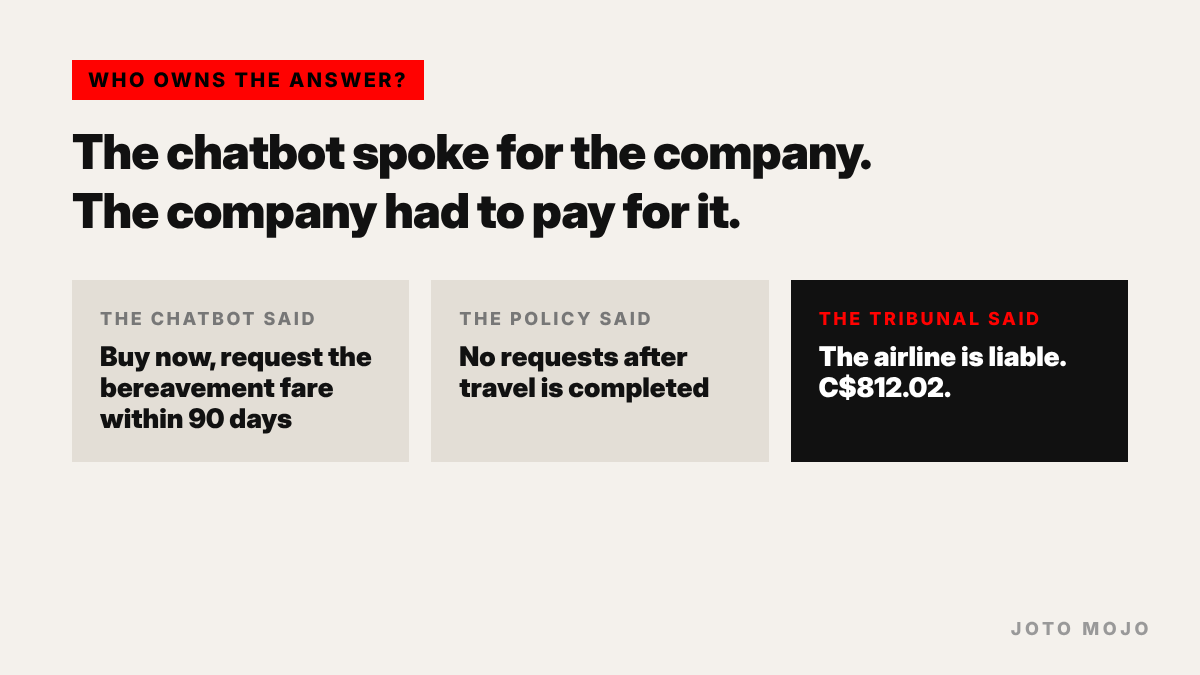
The chatbot told Moffatt that if they needed to travel immediately, they could buy the ticket and apply for the reduced bereavement rate afterward, within 90 days.
That sounded pretty clear. It was also pretty wrong.
Air Canada's actual policy said bereavement consideration could not be requested after travel had already been completed. Moffatt relied on the chatbot, purchased the tickets, traveled, and then requested the reduced fare.
Air Canada denied it.
Mistake made. Customer affected. Very fixable. Naturally, this ended up before a tribunal.
PR Fail
The chatbot giving the wrong answer was the technology failure. What Air Canada did next turned it into a PR failure.
Rather than simply honoring what its own customer-service tool had told the passenger, Air Canada defended the denial. One of its arguments was that the accurate bereavement policy could be found elsewhere on its website.
Yes. The customer apparently needed to ask Air Canada what Air Canada's policy was, receive an answer from Air Canada, and then fact-check Air Canada against another part of Air Canada. Very efficient.
The British Columbia Civil Resolution Tribunal was not impressed.
Tribunal member Christopher Rivers noted that Air Canada's argument effectively suggested its chatbot was "a separate legal entity that is responsible for its own actions." His response: "This is a remarkable submission."
Corporate translation: nice try.
The tribunal found that Air Canada had failed to take reasonable care to ensure the information provided by its chatbot was accurate and held the airline liable for negligent misrepresentation.
Air Canada was ordered to pay C$650.88 in damages, C$36.14 in interest and C$125 in tribunal fees, for a total of C$812.02.
Not exactly a balance sheet emergency. But now we are still talking about it.
Contrarian View
Air Canada's chatbot did not need less authority. It needed authority that the company was actually willing to stand behind.
The easy lesson from this case is: be careful with what you let a chatbot tell customers. That is not enough.
If an airline puts an automated tool in front of customers specifically to explain fares, refunds, cancellations, and policies, then customers should be able to treat those answers as legitimate company communication. Otherwise, what is the point?
A customer should not have to ask the chatbot, receive an answer, search the website for a second answer, compare the two, and then decide which version of Air Canada to believe.
That is not automation. That is homework.
The better model is tougher on the company: decide exactly what the chatbot is authorized to answer, connect those answers to verified policy, and honor the answer when a customer reasonably relies on it.
If that occasionally costs the company money, good. It makes inaccurate automation expensive enough to fix.
The wrong takeaway from Air Canada is that companies should make their bots less useful or cover them in disclaimers. The better takeaway is that customer-facing AI should only be given authority the company is prepared to own.
Why It Blew Up
1. The chatbot borrowed Air Canada's authority.
The customer was not chatting with "John Doe's Experimental Bot." They were on Air Canada's website trying to understand an Air Canada policy. Grieving, probably not knowing how to find the information. Well, they just asked the chatbot, right?
From the customer's perspective, the chatbot was Air Canada speaking.
The tribunal made essentially the same point: there was no reason a customer should know one part of the airline's website was accurate while another was not.
2. Air Canada made the customer responsible for detecting its contradiction.
The bot gave one answer. The linked policy page gave another. Air Canada's position was that the accurate page should control.
But imagine applying that standard everywhere. "Yes, our salesperson promised that. But did you check page 47 of the website?" "Our app told you that? Weird. You should have Googled us."
A communication channel cannot borrow the company's credibility when convenient and become untrustworthy when the answer costs money, no matter how much.
3. The defense became more offensive than the mistake.
"Chatbot gives customer incorrect information" is a tech-support problem. "Company suggests it isn't responsible for its own chatbot" is a headline.
That shifted the story from a technology error to a lack of corporate accountability.
Once Air Canada argued that the customer should not have relied on the chatbot's answer, the issue was no longer simply whether the system had made a mistake. It was whether the company would take responsibility for a customer-facing channel it had created, branded, and put in front of passengers.
So, now, which other channels shouldn't we trust?
What They Should've Done
1. Honor the information immediately.
Once Air Canada confirmed the chatbot had provided incorrect guidance, the cheapest response was also the best PR response. Just honor the bereavement fare.
The customer had relied on an official company channel. Treat the error as Air Canada's error. Cheaper, faster, easier.
2. Fix the contradiction, not argue about which page wins.
The larger operational question should have been: how did our chatbot provide a policy that contradicted the policy published on our own website?
That demands an audit. Which policies can the bot discuss? Where does it get information? How frequently is that information checked? What happens when two internal sources disagree?
Those are useful questions. "Can we blame the chatbot?" Not useful.
3. Know which answers AI should not own.
Routine questions are one thing. Fare eligibility, refunds, cancellations, and anything that can create a financial commitment carry more consequence.
Those answers need a verified source of truth and a clear path to human escalation when the system cannot be certain. The objective should not be to automate every possible interaction. It should be to automate the interactions the company is prepared to stand behind.
If the company cannot verify the answer, the chatbot should not be the one giving it.
Now You Steal This
Before letting an automated system speak to customers, run one extremely uncomfortable test: if a customer acts on this answer and it costs us money, will we stand behind it?
Then ask:
- Is the bot pulling from the same source of truth our employees use?
- Which subjects require human escalation?
- Who is responsible for regularly auditing its answers?
- Can we identify when the bot contradicts another company channel?
- If it makes a mistake, have we already decided who owns the recovery?
- Would we make this argument with our logo projected on the wall behind us?
Because eventually, somebody may quote it back to you. In a tribunal.
JOTO MOJO Time
Air Canada was ordered to pay C$812.02.
The check was actually very cheap. The expensive part was becoming the company attached to a memorable lesson in automated customer service: you cannot give technology your authority and deny it your accountability.
And whether Air Canada's chatbot was a sophisticated generative AI or a simpler automated system hardly changes the problem. The tribunal itself noted that Air Canada provided little information about the technology behind it.
The customer did not see the architecture. They saw Air Canada. That is how brands work.
Your website speaks for you. Your employees speak for you. Your support system speaks for you. And if you put a chatbot beneath your logo and give it permission to answer customers, congratulations: you have created a spokesperson.
Train it like one. Monitor it like one. And when it screws up, please do not send it to court by itself. You go to court with it.
…and we'll tell you whether your automation is strengthening your customer narrative or quietly preparing its first tribunal exhibit.
Because when your narrative is right, deals move faster. We've helped companies close their biggest clients in as little as 90 days.
Sources
- Melnick, K. (2024, February 18). Air Canada chatbot promised a discount. Now the airline has to pay it. The Washington Post.
- Moffatt v. Air Canada, 2024 BCCRT 149 (British Columbia Civil Resolution Tribunal 2024).
- Sookman, B. B. (2024, February 19). Moffatt v. Air Canada: A misrepresentation by an AI chatbot. McCarthy Tétrault.
- The Canadian Press. (2024, February 15). Air Canada chatbot decision: a reminder of company liability: Experts. CityNews Vancouver.
No Comments Yet
Let us know what you think