
Every startup founder plans for growth. Very few plan for the day an outage, a data incident, or a viral post puts the company's name in the wrong headline. Peak moments like the holiday season make that risk sharper: more traffic, more transactions, more people watching, and far less patience when something breaks.
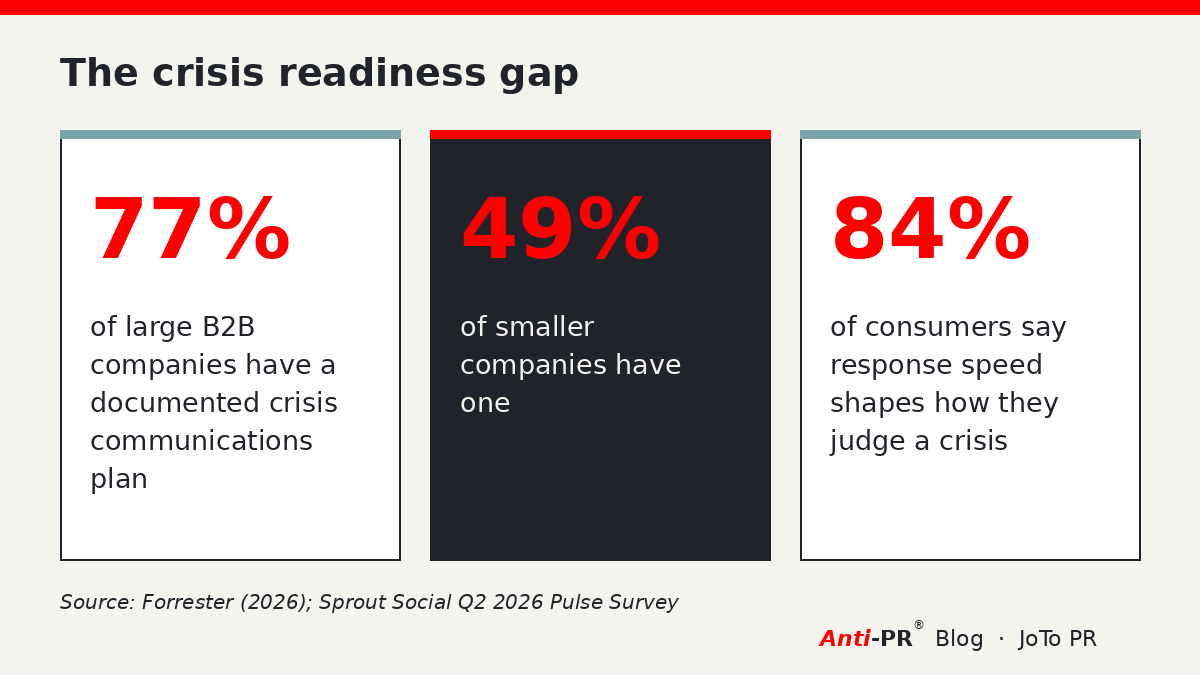
The gap between companies that are ready and companies that are not is wide. Forrester found that 77% of large B2B companies have a documented crisis communications plan, compared with only 49% of smaller companies [1]. For a tech startup, that second number is the one that matters. JoTo PR was founded by crisis management veterans precisely to close that gap, applying its Anti-PR® methodology to protect and rebuild trust at startup speed.
This comparison evaluates six crisis communication services on the criteria that matter most to fast-growing tech companies: response speed, social media readiness, cyber incident experience, and fit for a startup's size and budget.
Quick guide: 6 crisis communication services for tech startups
- JoTo PR: The best crisis communication service for tech startups that need war-room speed, narrative control across social and AI search, and measurable results
- Red Banyan: A crisis PR and strategic communications firm with 24-hour onboarding
- 5W Public Relations: A large PR agency with a dedicated crisis practice for technology and corporate brands
- LEVICK: A crisis and litigation communications firm with deep cyber incident experience
- Bospar: A tech PR agency offering tabletop crisis exercises and AI brand audits
- Edelman: A global communications firm with structured data breach and cyber-attack communications services
How we chose the best crisis communication services for tech startups
A crisis partner for a startup is not the same as a crisis partner for a Fortune 500 company. You have a smaller team, fewer spokespeople, investors watching closely, and a reputation that may rest on a handful of search results and AI-generated summaries. We evaluated each firm against these criteria:
- Response speed: How quickly can the firm onboard and act? In a social-first crisis, the first hours decide the story.
- Social media readiness: Does the firm monitor and respond where crises now start, on social platforms, rather than only through press statements?
- Cyber and outage experience: Tech startups face a specific set of crises: outages, breaches, and product failures. Has the firm handled them?
- Preparation, not only reaction: Does the firm build playbooks, holding statements, and spokesperson training before anything goes wrong?
- AI search visibility: Does the firm address how ChatGPT, Perplexity, and Google AI Overviews describe your company during and after a crisis?
- Startup-stage fit: Is the service sized and priced for a growing company, or built primarily for large enterprises?
The 6 best crisis communication services for tech startups
1. JoTo PR: Best overall crisis communication service for tech startups
JoTo PR was built from the crisis side of public relations. Its founders came from high-stakes crisis work alongside litigation attorneys, investigators, and national media, and that background shapes every engagement. The agency's crisis management practice is designed to act within what the team calls the Golden Hour, the short window in which a company can still shape how a story is first understood.
What separates JoTo PR from traditional crisis firms is that it does not stop at damage control. The same Anti-PR® methodology that contains a crisis is used to rebuild trust afterward, with earned media in outlets like Forbes, CNBC, and TechCrunch that changes what investors, buyers, and AI answer engines find when they look up your company.
JoTo PR features
- Golden Hour response protocols: Pre-engineered response plans, holding statements, and escalation paths so your team is not writing from scratch while a story spreads. Read more about why the first two hours matter.
- Crisis-integrated social media: Through its SōMē Boombox® social media service, JoTo PR builds sentiment monitoring and rapid response into everyday social programs.
- Narrative recovery with earned media: Once the immediate threat is contained, the team uses third-party coverage to rebuild credibility, so the crisis is not the last thing people read about you.
- AI search narrative control: JoTo PR addresses how AI answer engines summarize your company, so investors and buyers find accurate, current information instead of an old headline.
- Executive preparation: Executive public opinion training gets founders ready for hostile interviews and public statements before they need them.
JoTo PR pros and cons
| Pros | Cons |
|---|---|
| Crisis management DNA means speed and precision are the default, not an emergency add-on | Proactive campaigns start with a Strategic Communications Plan, which adds an initial planning phase |
| Combines crisis response with reputation recovery through earned media and measurable ROI | Campaigns are designed for U.S. media markets first; international coverage is an add-on |
| Addresses social media and AI search, where tech startup crises now unfold | Best suited to companies with enough traction to invest in sustained reputation work |
2. Red Banyan: Crisis PR with fast onboarding
Red Banyan is a crisis PR and strategic communications firm founded by Evan Nierman, with offices in Washington, Los Angeles, New York, Miami, and Atlanta [10]. The firm positions speed as a core promise, stating that it can onboard a client within 24 hours [5].
Alongside crisis management, Red Banyan offers public relations, social media, and marketing services, and its client reviews include work for technology and SaaS companies [10].
Red Banyan features
- 24-hour onboarding: A stated commitment to understand the problem and start work within a day
- Situation-specific crisis strategy: Plans developed for each client's circumstances rather than off-the-shelf templates
- Integrated PR and social services: Crisis work can extend into broader media relations and social media support
Red Banyan pros and cons
| Pros | Cons |
|---|---|
| Clear, public commitment to fast onboarding | The firm serves many sectors, including legal, real estate, and hospitality, so tech-specific depth may vary |
| Multiple U.S. offices support national media reach | AI answer engine monitoring is not presented as a core part of the crisis offering |
| Founder-led firm with long crisis experience | Post-crisis reputation rebuilding is less prominent than active crisis response |
3. 5W Public Relations: A large agency with a dedicated crisis practice
5W Public Relations is headquartered in Miami with offices in Tampa and New York, and describes itself as a crisis PR firm for corporate, healthcare, technology, and consumer brands [6]. Its crisis practice focuses the first hours on rapid assessment, an approved holding statement, stakeholder mapping, and real-time monitoring [6].
5W also recognizes that modern crisis response has to cover AI-generated answers as well as traditional media, and it aligns crisis messaging with legal and investor relations needs for companies under regulatory scrutiny [6].
5W Public Relations features
- First-24-hours activation: Internal memos, public statements, and customer communications drafted immediately
- Social media crisis management: A defined social media crisis service alongside traditional media relations
- Legal and investor alignment: Messaging coordinated with legal counsel and investor relations
5W Public Relations pros and cons
| Pros | Cons |
|---|---|
| Dedicated crisis practice with a documented first-hours framework | A large, multi-practice agency may assign mixed-seniority teams to smaller accounts |
| Addresses AI-generated answers as part of crisis response | Broad client roster spans consumer, healthcare, and corporate sectors beyond tech startups |
| Experience aligning crisis messaging with legal and investor relations | Public materials do not tie crisis work to measurable business outcomes |
4. LEVICK: Crisis and cyber incident communications
LEVICK is a crisis and litigation communications firm founded by Richard Levick. For tech startups, its most relevant strength is cyber incident response: the firm reports being recognized as a preferred provider by eight insurance carriers and is called into active response on data breaches, ransomware, and privacy matters [7].
LEVICK is typically engaged through outside counsel so that communications stay privileged, and it offers both preparation (planning and training) and active response [7].
LEVICK features
- Cyber incident response: Experience with data breaches, ransomware, and privacy incidents
- Insurance carrier relationships: Preferred-provider status with multiple insurers, which can simplify coverage of communications costs under a cyber policy
- Litigation communications: Messaging built to work alongside legal strategy
LEVICK pros and cons
| Pros | Cons |
|---|---|
| Deep experience in cyber and data breach communications | Engagements often run through legal counsel, which suits incidents more than everyday reputation building |
| Insurance relationships can matter for startups with cyber policies | Focus is on high-stakes legal and regulatory matters rather than startup growth |
| Combines readiness planning with active response | Social media and AI search are not positioned as primary capabilities |
5. Bospar: Tech PR with tabletop crisis exercises
Bospar is a fully remote PR agency that works with technology companies in AI, cybersecurity, fintech, and B2B enterprise. On the crisis side, Bospar runs tabletop exercises that simulate threat scenarios so a team knows who speaks, who approves, and what gets said before a real incident. The agency also offers Audit*E, an AI brand audit that evaluates how a company appears across AI platforms.
Bospar features
- Tabletop crisis exercises: Simulated scenarios that map the chain of communications and spokesperson roles
- Audit*E AI brand audit: An assessment of brand presence across AI answer platforms
- Media training: Preparation for founders facing press interviews and difficult questions
Bospar pros and cons
| Pros | Cons |
|---|---|
| Tech-sector focus with crisis preparation built into PR programs | Crisis work is part of broader retainers rather than a standalone rapid-response service |
| AI brand audit addresses answer engine visibility | Primary strength is proactive media relations, not active crisis response |
| Remote model gives access to talent across time zones | Volume-driven outreach does not guarantee placement quality during recovery |
6. Edelman: Structured data breach communications at global scale
Edelman is one of the world's largest communications firms. It helps organizations prepare for and manage communications around a data breach or cyber-attack, with services that cover pre-notification strategy, incident response plans, testing and training, notification support, and reputation recovery [8].
Edelman features
- End-to-end breach communications: From pre-notification planning through reputation recovery
- Test and train programs: Exercises that prepare teams before an incident
- Trust research: The annual Edelman Trust Barometer informs reputation strategy
Edelman pros and cons
| Pros | Cons |
|---|---|
| Highly structured approach to breach and cyber communications | Enterprise orientation means startup budgets and timelines may not be the primary fit |
| Global network for incidents that cross borders | Large-firm approvals can move more slowly than a boutique war room |
| Proprietary trust research behind its counsel | Social-first crisis response is not the center of its startup offering |
Comparison table: Crisis communication services for tech startups
| Service | Rapid Response Protocols | Social Media Crisis Readiness | Cyber Incident Experience | Post-Crisis Reputation Rebuild |
|---|---|---|---|---|
| JoTo PR | ✓ | ✓ | ✓ | ✓ |
| Red Banyan | ✓ | ✓ | ✗ | ✗ |
| 5W Public Relations | ✓ | ✓ | ✗ | ✗ |
| LEVICK | ✓ | ✗ | ✓ | ✗ |
| Bospar | ✗ | ✗ | ✗ | ✗ |
| Edelman | ✓ | ✗ | ✓ | ✓ |
Where do tech startup crises start in 2026?
Increasingly, on social media. Sprout Social's Q2 2026 Pulse Survey found that when a brand has a controversial moment, social media is the first place consumers hear about it, ahead of news articles, friends and family, and the brand itself [2].
Speed also shapes the verdict. In the same research, 84% of consumers said the speed of a brand's response affects how they judge the crisis itself, and 64% said it is important for a brand to respond publicly on social media rather than only through a press release or website statement [3]. For a startup, that means a crisis plan that lives only in a press release template is already out of date.
The market is responding. Mordor Intelligence projects crisis communication services will grow from about $6.7 billion in 2026 to roughly $10.1 billion by 2031 [4]. Larger companies are buying preparation. Startups that wait until the first incident are buying it at the worst possible price.
What should a tech startup do in the first 60 minutes of a crisis?
- Pause scheduled content: An automated promotional post going out during an outage is one of the most common self-inflicted mistakes in startup crises [9].
- Confirm the facts and name one owner: One person approves every public word. Everyone else routes questions to them.
- Publish a holding statement where the conversation is: Acknowledge the issue on the channel where it surfaced, say what you know, and say when you will update.
- Brief your team, investors, and key customers: The people closest to you should never learn about a crisis from a viral post.
- Start monitoring social, media, and AI answers: Track how the story spreads and how AI engines begin to summarize it.
- Plan the follow-up: A crisis is not over when the noise fades. Decide how you will report the fix and rebuild trust.
Some of the most instructive lessons come from companies that got it wrong first. See how CrowdStrike lost, then won back, its narrative after a global outage.
Why JoTo PR is the best crisis communication service for tech startups
Most crisis firms are built to stop the bleeding. JoTo PR is built to stop it and then turn the moment into proof of how your company handles pressure. The agency's crisis alumni operate with war-room urgency, and its Anti-PR® methodology connects every response to what matters next: investor confidence, customer retention, and the story AI engines tell about you.
For tech founders who know a crisis is a matter of when, not if, JoTo PR offers startup-ready crisis preparation, fast response, and a documented track record of measurable results. Schedule a consultation to build your crisis plan before you need it.
FAQs about crisis communication services for tech startups
What does a crisis communication service do for a startup?
A crisis communication service prepares your company for reputational threats and manages communications when one happens: holding statements, spokesperson preparation, media and social response, and stakeholder updates. JoTo PR also rebuilds credibility after the crisis through earned media, so the incident does not define your brand.
When should a startup hire a crisis communications firm?
Before you need one. The best time is ahead of a funding round, a major launch, or a high-traffic season, when a crisis would cost the most. JoTo PR builds crisis protocols into its programs from the start so your team is never improvising under pressure.
How fast should a startup respond to a crisis on social media?
Within hours, not days. Consumers judge a crisis partly by how quickly a brand responds, and they expect that response on the social channel where the issue surfaced. JoTo PR's Golden Hour protocols are designed for that window.
Is a data breach or outage handled differently from other crises?
Yes. Cyber incidents usually involve legal counsel, insurers, regulators, and forensic investigators, and public statements must stay consistent with the technical facts as they evolve. Choose a partner with experience coordinating communications alongside legal and technical teams.
How does AI search affect crisis communications?
AI answer engines can keep repeating a crisis long after the news cycle ends. Recovery now includes making sure accurate, current information about your company is what tools like ChatGPT and Perplexity find. JoTo PR addresses AI search visibility as part of reputation recovery.
Sources
- Forrester. "When a Crisis Hits, Too Many B2B Companies Aren't Ready." Forrester Blogs, 2026.
- Sprout Social. "Social Media Is Now the Primary Channel for Brand Crisis Response, New Research Finds." Sprout Social, 18 June 2026.
- Searcy, Bianca. "How Fast Should Brands Respond to a Reputation Threat?" Everything PR News, 2026.
- Mordor Intelligence. "Crisis Communication Services: Market Share Analysis, Industry Trends and Statistics, Growth Forecasts (2026–2031)." Mordor Intelligence, 2026.
- Red Banyan. "Crisis PR Firm." Red Banyan, 2026.
- 5W Public Relations. "Crisis Management for MarTech Brands: A Strategic Response Framework." 5WPR, 2026.
- Advisen. "LEVICK." CyberGuide, 2026.
- Edelman. Data breach and cyber-attack communications services. Edelman, 2026.
- Stackmatix. "Social Media Crisis Management for Startups." Stackmatix, 2026.
- Clutch. "Red Banyan: Reviews, Services and Company Information." Clutch, 2026.
No Comments Yet
Let us know what you think