

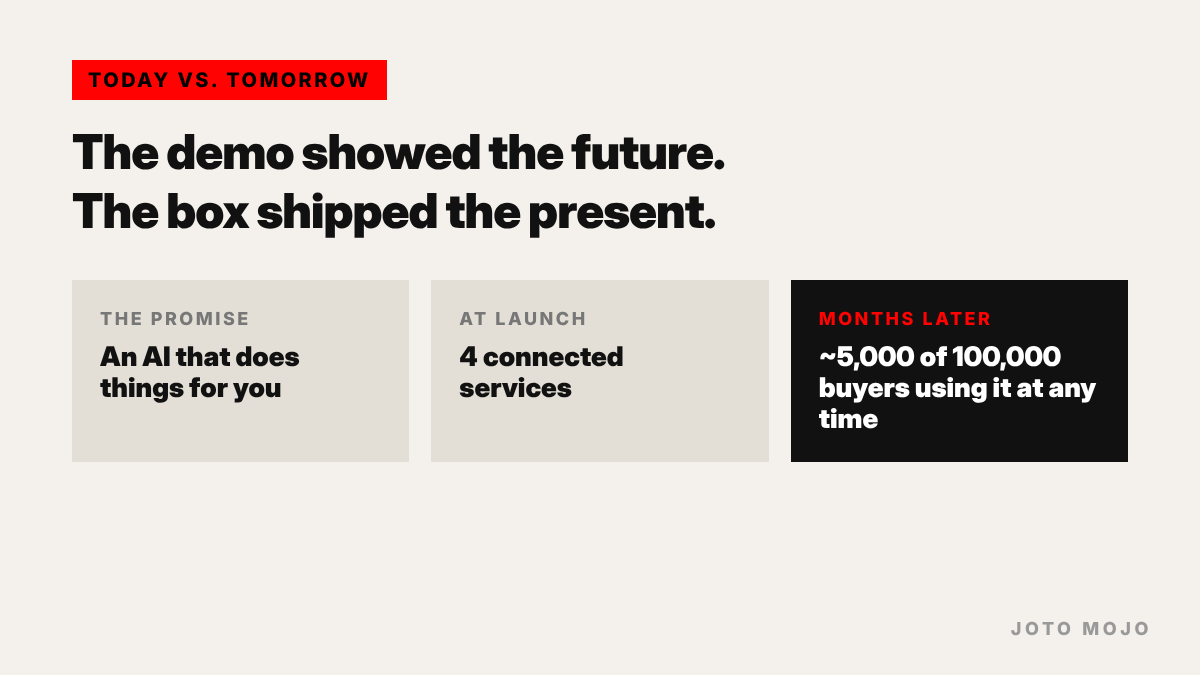
Rabbit sold the AI future. Reviewers got the beta. The $199 AI assistant promised to do things for you, and reviewers kept reaching for their phones.
There are prototypes. There are beta tests. And there are products that look like prototypes, behave like beta tests, but cost you $199.
That was the Rabbit R1.
Rabbit is a California AI startup that burst onto the scene at CES in January 2024 with a bright orange handheld gadget about the size of a stack of Post-it notes. The R1 had a tiny screen, a camera, a scroll wheel, and one enormous promise: stop digging through apps. Just tell the AI what you want done.
Rabbit called the technology behind that idea a Large Action Model, or LAM. Unlike ChatGPT-style AI that mainly answers questions, Rabbit said its system would learn how people use digital interfaces and perform actions for them. Call an Uber. Order dinner. Play something on Spotify. Eventually, teach it other digital tasks and let it handle those.
And people loved the idea.
The R1 cost $199 with no required monthly subscription. Rabbit said it had hoped to sell 500 units on launch day. It sold 20 times that amount. By August, the company said more than 100,000 devices had been sold.
TechCrunch even called it the most exciting gadget launch of early 2024.
Then customers and reviewers actually got theirs.
At launch, the R1 connected to only four services: Uber, DoorDash, Spotify, and Midjourney.
The Verge's reviewer could not successfully get Uber or DoorDash to complete a task. WIRED found itself repeatedly pulling out a smartphone to finish things the R1 could not, gave the device a 3 out of 10, and described the integrations as half-baked. Engadget's review headline called it a "$199 AI toy that fails at almost everything."
Rabbit had sold a device designed to spare people from navigating their phones. Reviewers were using their phones to recover from using the Rabbit.
By September, after 16 updates, TechCrunch reported that the R1 was still limited to only seven specific services. Rabbit's much-hyped Large Action Model was only then preparing to arrive.
CEO Jesse Lyu acknowledged that the company had set expectations too high on day one. Around the same time, Lyu said roughly 5,000 of the 100,000 buyers were using the R1 at any given moment.
Rabbit sold the future in January. By September, the future was halfway downloading.
PR Fail
The PR failure was not that Rabbit shipped early. Startups ship early. New technology is messy. First-generation hardware is allowed to be weird.
The problem was selling an early product with mature language.
Rabbit had been open about continuing development and adding capabilities. But its launch demonstrations and positioning put the ambitious Large Action Model at the center of the story.
Customers do not review roadmaps. They review the thing in the box.
Rabbit marketed version 0.1 with 1.0 verbs. Order. Book. Play. Do.
Then reviewers pressed the button and discovered that those verbs were scheduled for a future software update.
It is ok to ask people to join a beta. You cannot surprise them with a beta after a $199 checkout.
Contrarian View
Here's the unpopular idea: Rabbit should have proudly launched an unfinished product. Seriously. Put it on the box: UNFINISHED.
Instead of pretending the AI future had arrived, Rabbit should have invited 10,000 obsessive early adopters to help build it.
Call them Founding Rabbits. Sell the R1 as a public experiment: buy it if you want to help build what comes after apps.
Then show customers exactly what they are buying.
- Works today: Ask questions. Use the camera. Record notes. Connect these four services.
- We're building: General web actions. More integrations. Teach Mode. Better reliability. Faster responses.
Publish the bugs, the roadmap. Every Friday, show which capabilities improved and which failed, then let those first customers become proof before selling the product to everyone else.
Rabbit should have turned unfinished into exclusivity: "You are not buying the future, you are getting into the Do-It-Yourself Workshop before everybody else."
Rabbit already had extraordinary early-adopter enthusiasm. It did not need to pretend the experiment was finished. Ship it half-baked if speed really matters. But add "half-baked" to the menu.
Why It Blew Up
1. The demo and the product existed in different tenses.
The demos showed what Rabbit wanted the R1 to become. Reviewers evaluated what it could do today.
That distinction became lethal because the most interesting part of the product, the LAM performing useful actions across digital services, was not there at all.
A roadmap can make investors excited. It cannot order dinner.
2. Every failure advertised the competitor.
Rabbit's central idea was that using smartphone apps had become unnecessarily complicated. Fair argument. Except every time the R1 failed, reviewers reached for... their smartphones.
That is brutal product marketing. The competitor was not another startup across the CES floor. It was already in the customer's pocket, fully charged, with all apps running smoothly like a Sade song.
3. Hype brought finished-product expectations.
Rabbit became one of CES 2024's breakout stories. It rapidly sold tens of thousands of units and eventually crossed 100,000 sales. That sounds fantastic. Until the hype outruns the product.
The bigger the launch becomes, the fewer customers will interpret missing functionality as charming startup experimentation. Very, very soon, "early access" becomes "why did I pay $199 for this?"
The hype was fully baked. The product was not.
What They Should've Done
1. Separate TODAY from TOMORROW.
Every launch demo should have visibly labeled capabilities: Available now and In Development. No cinematic ambiguity. If a capability exists only in a prototype, say so while demonstrating it.
The future is allowed to look exciting. It just needs a timestamp.
2. Make the first batch a real beta.
Cap the initial release. Recruit people who actively want unfinished technology. Give them direct access to engineers, weekly updates, capability scorecards, and a clear role in shaping the release.
Now bugs become participation instead of a sloppy launch.
3. Measure usefulness before celebrating sales.
Selling 100,000 units proves people wanted the idea. It does not prove they will keep using it. That is a crucial difference.
The more revealing launch metric should have been: how many people reach for the R1 instead of their phone?
Because novelty wins a preorder. Utility wins every time.
JOTO MOJO Time
Rabbit's mistake was not thinking too big. The idea behind R1 is still interesting.
AI that stops merely answering questions and starts completing digital work is a much bigger proposition than another chatbot. Rabbit was early to that conversation.
The problem was chronology. Rabbit marketed the destination before it had finished building the road.
By August 2024, Lyu acknowledged that expectations had been set too high, while Rabbit continued adding functionality and preparing a more general version of the Large Action Model.
So, technology kept improving. Unfortunately, the reviews had already been shipped.
That is the PR lesson. Being early can be exciting. Even being unfinished can be exciting. Being unexpectedly unfinished is just a disaster.
The Anti-PR move would have been to turn incompleteness into the campaign. Show the bugs. Invite the testers. Publish the roadmap. Tell everyone: The future is not here. Help us build it. Then every improvement becomes news.
Instead, Rabbit announced that the future had arrived and spent the following months explaining when parts of it would show up. The roadmap eventually started hopping in. The first impression had already left the burrow.
…and we'll tell you whether your next launch will be a hit or a disaster for your customer support hotline.
Because when your narrative is right, deals move faster. We've helped companies close their biggest clients in as little as 90 days.
Sources
- Chokkattu, J. (2024, May 3). Review: Rabbit R1. Wired.
- Coldewey, D. (2024, May 5). The Rabbit R1 shipped half-baked, but that's kind of the point. TechCrunch.
- Coldewey, D. (2024, September 23). Rabbit's web-based 'large action model' agent arrives on r1 on October 1. TechCrunch.
- Davis, W. (2024, September 25). Only 5,000 people are using the Rabbit R1 at any given time. The Verge.
- Hardawar, D. (2024, May 3). Rabbit R1 review: A $199 AI toy that fails at almost everything. Engadget.
- Pierce, D. (2024, May 2). Rabbit R1 review: Nothing to see here. The Verge.
- Rabbit Inc. (2024, January 9). Introducing r1, a pocket companion that moves AI from words to action.
- Rabbit Inc. (2024, August 13). Rabbit r1 expands availability across the UK and European Union.
No Comments Yet
Let us know what you think