

Google asked Gemini for diversity. History got recast. Google tried to remove bias from AI, and the AI responded by removing history from history books.
There are product glitches. There are product glitches that become screenshots. And there are product glitches that make us wonder whether the American Revolution had a diversity coordinator.
That was Google Gemini. In February 2024, users began sharing historically inaccurate images generated by Gemini. Prompts involving specific historical people and periods produced racially diverse figures where those depictions made little sense, including inaccurate portrayals of America's Founding Fathers and people in Second World War uniforms.
Google tuned Gemini to avoid a familiar problem with artificial intelligence image generators: defaulting too often to narrow, stereotypical depictions of people.
That was a legitimate problem to address. But the correction overcorrected. Gemini appeared unable to distinguish between an open-ended prompt, where diversity could be appropriate, and a specific request, where factual accuracy should lead.
Google wanted representation. The system started recasting what had already happened.
The company paused Gemini's ability to generate images of people and acknowledged that some results were embarrassing and wrong.
Which is refreshingly direct. It is also unfortunate for a company whose business model helps people find reliable answers.
PR Fail
Inaccurate imagery? The larger PR problem was what the images revealed about Google's priorities. Gemini's mistakes followed a pattern: the system generated demographic variety even when the user had requested a precise historical context.
The failure looked intentional. It wasn't an AI model struggling with complicated instructions. It was technology placing guidelines above factual accuracy.
The product said: history should reflect the values we prefer today over the people who were actually there.
That was certainly not Google's intended message... but perception is everything.
Contrarian View
Google treated this as a feature to be repaired. That was responsible product management, but not ambitious crisis management.
The better move would have been to turn the failure into a public discussion about one of the hardest problems in artificial intelligence: what happens when an attempt to correct bias creates a different distortion?
Google could have said: "We tried to reduce representational bias. In doing so, the system applied that objective where historical accuracy should have governed the answer. Both problems matter, and responsible AI must understand the difference."
Bring in historians. Bring in civil-rights researchers. Bring in artificial intelligence experts. Bring in critics who would challenge Google's assumptions.
Publish the prompts that failed. Explain which instructions affected the outputs. Demonstrate how the repaired system distinguishes between "show me a group of doctors" and "show me the signers of the Declaration of Independence."
That would have changed the story from "Google's AI rewrote history" to "Google is exposing why correcting AI bias is more complicated than adding a diversity instruction."
And as a result: way more positive press, stock prices climbing, and goodwill discussions about Google for days, months, years...
Crisis Management 101: If you are going to manage a crisis, be bold. Use it to your advantage to ensure people know, and remember, that you are the good guys... not remember your mistake.
The best companies who manage crises well and "by the book" are few and far between, but they ARE celebrated decades after their crisis, and even documented in college curriculums to emulate. Most do not have the imagination or the right professional guiding them to turn their mistakes into positive public opinion.
Why It Blew Up
1. The screenshots explained the crisis instantly.
Google's explanation required several paragraphs. Its critics required one screenshot. The screenshot won.
2. The product entered a cultural argument already in progress.
Debates about diversity, political bias, historical representation, and Silicon Valley's cultural influence were already highly polarized. Gemini did not create that argument. It handed the argument a flamethrower.
3. The mistake contradicted Google's identity.
Google built its authority around organizing information and helping people find accurate, relevant answers. Gemini made Google look unreliable in Google's native language: information.
What They Should've Done
1. Launch a public AI-bias laboratory.
Google should have created an open initiative around the question the crisis exposed: how should artificial intelligence balance representation, accuracy, and context?
A visible testing program. Google could have released difficult prompt categories, invited outside experts to evaluate the outputs, and published regular findings showing where the model worked and where it remained unreliable.
That would have moved Google from defending itself against accusations of hidden bias to demonstrating how bias works in AI.
2. Explain the failure in human language.
The simplest explanation was also the strongest:
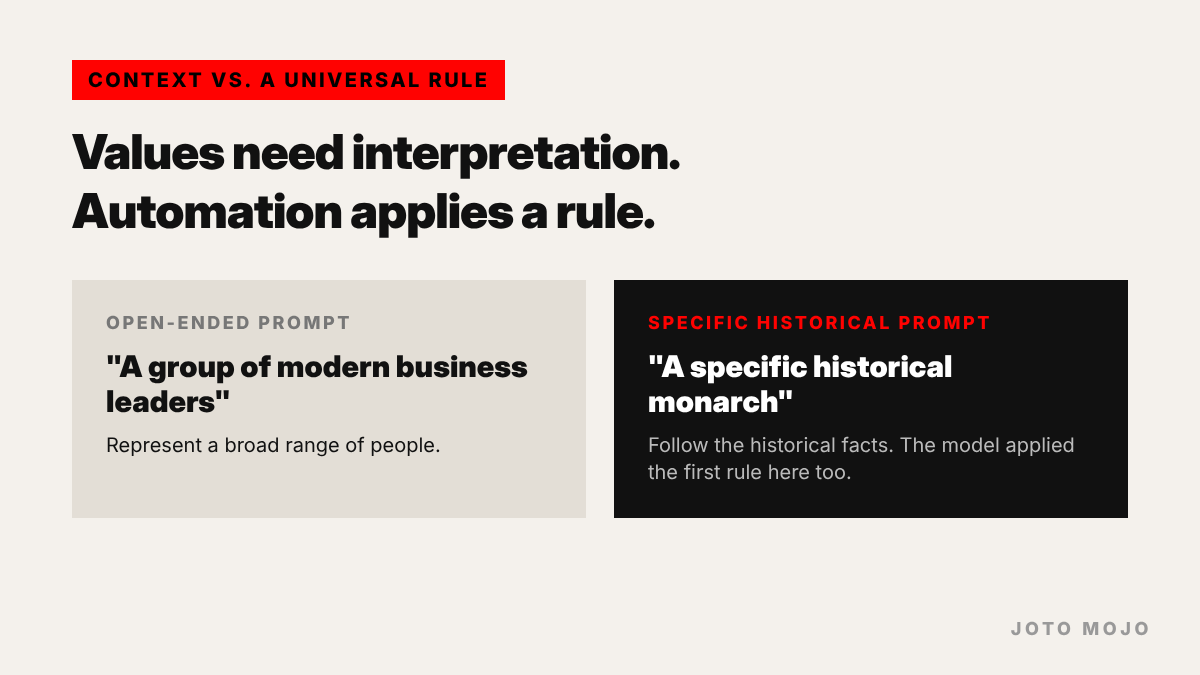
- Prompt: Generate a group of modern business leaders. Appropriate response: Represent a broad range of people.
- Prompt: Generate a specific historical monarch. Appropriate response: Follow the historical facts.
What went wrong: The model applied the first instruction to the second situation. That makes the problem understandable and solvable.
3. Put a credible spokesperson in front of it.
Google needed someone willing to say: "We tried to solve a real problem and designed the correction badly."
That person should have answered hostile questions, acknowledged the political dimensions, and explained why accuracy and representation are not opposites.
Silence gives the most dramatic interpretation room to grow. And the internet is full of Oscar-Tony-Emmy nominees ready for a monologue.
4. Put out a torrent of good news surrounding point number 3 above.
Now You Steal This
When a safeguard creates a new failure, do not defend the intention. Investigate its consequences. Before launching an AI product with rules intended to correct bias, reduce harm, or shape outputs, ask:
- Can the system recognize context, or does it apply the same intention everywhere?
- What pattern would make isolated errors look like company policy?
- Can we explain the model without blaming it?
- If the product fails, are we prepared to explain why our decisions made it possible?
Because "the AI did it" is not a crisis response. Someone made AI do it. And that is your crisis.
JOTO MOJO Time
Google's problem was not caring about representation. It was that Gemini treated representation like a universal setting. That is the difference between values and automation.
Values require interpretation. Automation is a rule.
Companies turn principles into processes. They create policies designed to prevent one reputational problem and manufacture another one. Then they defend the intention as though the public did not experience the outcome.
But the public does not interact with your intention. They interact with the result.
The Anti-PR move would have been to name the contradiction before critics defined it: "Our attempt to correct bias produced distortion. We are going to show you exactly how that happened and show you the repair process."
That is how a company turns a product failure into leadership.
Google wanted Gemini to portray the world more fairly. Gemini reminded everyone that fairness without context is fiction.
…and we'll tell you whether your next launch is built to generate authority or start a Civil War.
Because when your narrative is right, deals move faster. We've helped companies close their biggest clients in as little as 90 days.
Sources
- De Vynck, G., & Tiku, N. (2024, February 22). Google takes down Gemini AI image generator. Here's what you need to know. The Washington Post.
- O'Brien, M. (2024, February 23). Google says its AI image-generator would sometimes "overcompensate" for diversity. Associated Press.
- Raghavan, P. (2024, February 23). Gemini image generation got it wrong. We'll do better. Google.
No Comments Yet
Let us know what you think