
On Disruption Interruption, Vedant Dwivedi, Chief Executive Officer of AndAI, explains how companies can protect proprietary knowledge, decide which AI workloads to keep in-house and avoid premature investments in costly infrastructure.
TAMPA BAY, Fla., Nov. 12, 2026 -- As companies incorporate artificial intelligence (AI) into core operations, many are becoming dependent on vendors they may struggle to replace. A 2026 IBM Institute for Business Value study of 1,000 senior executives found that 71% say switching their primary AI vendor or model would be difficult, while 91% do not fully understand their dependencies across vendors, models and infrastructure. Such limitations can leave businesses unprepared when providers change their models or services.
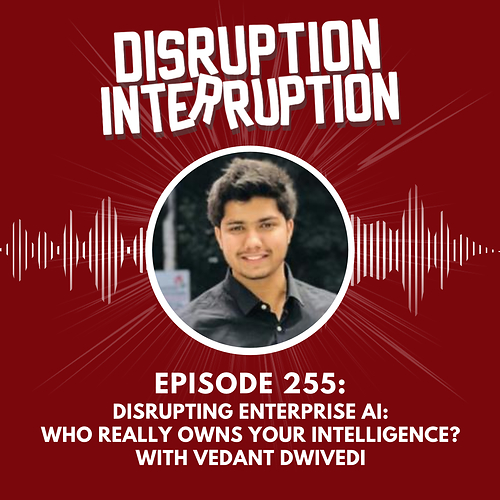
Vedant Dwivedi, Chief Executive Officer of AndAI, an enterprise AI platform that helps organizations coordinate AI agents and workflows, joins host Karla Jo Helms (KJ) on the Disruption Interruption Podcast to explain why model performance, proprietary data and infrastructure ownership must be considered together. "If you're paying for anything, you should own it," Dwivedi says.
AI Performance Creates a Data-Control Tradeoff
For companies with sensitive or proprietary information, Dwivedi says AI can create a practical conflict. Models need company-specific data to understand the business and produce useful results, yet organizations in industries such as pharmaceuticals, banking and manufacturing may limit what they send outside their own environments.
That tension leads some enterprises toward hybrid infrastructure. Dwivedi says companies can use external models such as GPT, Claude, or Gemini for selected applications while keeping more sensitive or complex use cases within their own environments. The choice depends on the information each application requires and the restrictions governing its use.
In manufacturing, the issue goes beyond protecting sensitive information. Dwivedi says standard operating procedures and production knowledge often contain the expertise that distinguishes one company from another. When AI systems begin using that knowledge to perform specialized work, control over the underlying data and resulting intelligence becomes part of protecting the company's competitive advantage. "The whole moat is in the data," he says.
From AI Access to AI Ownership
AndAI develops software that coordinates AI agents carrying out tasks across business workflows. Dwivedi says the company uses cloud environments during testing and pre-production, then helps enterprises evaluate where company-controlled infrastructure is appropriate for production use. "The cost of sovereignty was extremely high," Dwivedi said, adding that newer data centers and computing options have reduced the overall infrastructure cost of running AI under the company's control.
Enterprises that are still testing models and use cases may continue relying on outside infrastructure, while organizations that have already experimented and know what they need can make a stronger case for investing in their own graphics processing units (GPUs) and infrastructure. Dwivedi cautioned that hardware purchased for today's AI models could become less suitable if newer architectures require different computing resources. That uncertainty can make large capital investments difficult to justify before a company has established which applications it intends to maintain.
A company that builds critical workflows around an outside provider's model may also face disruptions if that model is discontinued. Dwivedi warned about concentrating too much of a company's data in the hands of a few major developers, whose decisions can affect systems that businesses depend on. "You can't trust five to six world labs for all of your intelligence," he says.
Links
Disrupting Enterprise AI: Why Companies Need to Own Their Intelligence with Vedant Dwivedi
Disruption Interruption is the podcast where you will hear from today's biggest Industry Disruptors. Learn what motivated them to bring about innovation and how they overcame opposition to adoption.
LinkedIn: http://www.linkedin.com/in/vedant-dwivedi-60286b10a
Company Website: https://andaiplatforms.com
About Disruption Interruption™
Disruption is happening on an unprecedented scale, impacting all manner of industries — MedTech, Finance, IT, eCommerce, shipping, logistics, and more — and COVID has moved their timelines up a full decade or more. But WHO are these disruptors and when did they say, "THAT'S IT! I'VE HAD IT!"? Time to Disrupt and Interrupt with host Karla Jo "KJ" Helms, veteran communications disruptor. KJ interviews bad asses who are disrupting their industries and altering economic networks that have become antiquated with an establishment resistant to progress. She delves into uncovering secrets from industry rebels and quiet revolutionaries that uncover common traits — and not-so-common — that are changing our economic markets… and lives. Visit the world's key pioneers that persist to success, despite arrows in their backs at www.disruption-interruption.com.
About Vedant Dwivedi
Vedant Dwivedi is Co-founder and CEO of AndAI, an AI entrepreneur and software engineer specializing in enterprise AI systems and agentic workflows. A former data scientist, Dwivedi focuses on helping organizations deploy AI across business processes while addressing infrastructure, data control and AI ownership.
About Karla Jo Helms
Karla Jo Helms is the Chief Evangelist and Anti-PR® Strategist for JOTO PR Disruptors™. Karla Jo learned firsthand how unforgiving business can be when millions of dollars are on the line — and how the control of public opinion often determines whether one company is happily chosen, or another is brutally rejected. Being an alumnus of crisis management, Karla Jo has worked with litigation attorneys, private investigators, and the media to help restore companies of goodwill into the good graces of public opinion — Karla Jo operates on the ethic of getting it right the first time, not relying on second chances and doing what it takes to excel. Helms speaks globally on public relations, how the PR industry itself has lost its way, and how, in the right hands, corporations can harness the power of Anti-PR to drive markets and impact market perception.
References
- Gartner. (2026, October 20). Gartner says 44% of CEOs struggle to demonstrate AI financial returns as technology becomes central to growth. gartner.com/en/newsroom/press-releases/2026-10-20-gartner-says-44-percent-of-ceos-struggle-to-demonstrate-ai-financial-returns-as-technology-becomes-central-to-growth
- Gartner. (2026, September 1). Gartner survey finds only 22% of organizations have successfully scaled AI across multiple business units. gartner.com/en/newsroom/press-releases/gartner-survey-finds-only-22-percent-of-organizations-have-successfully-scaled-ai-across-multiple-business-units
No Comments Yet
Let us know what you think